Category Archives: Parenting Peacefully

Labels are Not For Children

“Being Labeled is like being judged for life. It is like your future is laid out for you already”.
~ Author Unknown

We have always tried not to put labels on our children. The personalities are completely different from each other we love that about them. We never want them to think that one is better or more endearing than another or that one is weak vs strong or shy vs outgoing etc.

Labels are Not for Children

I remember as a child I was always called the shy, quiet and sensible one whilst my brother was the adventurous yet naughty one and my sister the fun-loving tom boy. I hated being put into my role and found it so difficult to break out of as an adult.

 Faber and Mazlish, authors of Siblings Without Rivalry  (Affiliate link) state that:

“We need to prepare our children for life outside the family. And life demands that we assume many roles. We need to know how to care for and be cared for; how to be leaders and followers; how to be serious and a little ‘wild’; how to live with disorder and how to create order. Why limit our children? Why not encourage all of them to take chances, explore their potential, discover strengths they never dreamed lay within them.”

We had a little incident here the other day which really brought home how important it is not to confuse the behaviour of a toddler in the highly volatile 1-3 year age bracket with their actual personality and demeanour. Even more important is to ensure we do not label or even perceive them as such things as shy, helpless, dominant, aggressive, victim, bully etc.

It is a short story but one which stopped us in our tracks and has given us a little more insight into the morphing minds of our children. Our oldest child, Lucy (2.5 years) has always been a very active, fun loving little girl who craves attention and approval. She was put into the role of ‘big sister’ when she was only 13 months old and has had some difficulty accepting this role and all it entails.

Her younger sister, Penny (1.5 years) has borne the brunt of some unmet needs in Lucy and has had to deal with some physical and verbal altercations with her older sister from a young age.

Of course, we have always been well aware of the emotions charging through these situations and have used all manner of methods to ensure a) Penny is kept safe and b) Lucy is helped through her feelings of anger and rage with acknowledgements and understanding. We haven’t always got it right but we are slowly refining our methods and we see improvements on a daily basis.

Penny is an independent and goal-oriented child. She shows remarkable perseverance and determination for a child her age and will try many different ways of achieving the outcome she desires before giving up or demanding help. This determination has seen her become quite frustrated when her play is interrupted by her rambunctious older sister who seems to have a desire to control all of Penny’s movements including her play and care giving moments. It has therefore been easy to fall into the trap of seeing Penny as the helpless victim and Lucy as the dominating perpetrator however, as we are slowly realising, not all is as it seems.

This afternoon, Penny had climbed into my husband’s ute in the driveway, soon after he arrived home from work. Penny absolutely loves playing in the cars, standing up in the drivers seat pretending to drive and climbing in and out of the car seats in the back. Today, she chose to sit in Lucy’s car seat and was happily doing so for about 10 minutes when Lucy, noticing Penny playing in there, started heading towards the open door of the ute (the front passenger door). As she climbed in, my husband and I signalled to each other that we had better get over there as Lucy was not going to be happy that Penny was in her seat. We quickly moved over, ready to sportscast the ensuing battle and protect Penny from any potential lashings but were taken aback by the five occurrences which followed.

1. Lucy made her way between the two front seats, passed by Penny sitting in her seat and happily sat down in Penny’s car seat. No battle!

2. Penny immediately began crying hysterically because Lucy was sitting in her seat. In the small breath pauses between each ear piercing cry, I managed to sportscast the situation as it occurred. “Penny, you don’t want Lucy to sit in your seat.” Pause for more crying “You are very upset that Lucy is sitting in your seat.” Pause and wait

3. Lucy climbs out of Penny’s seat and says: “Here you go, Penny”.

4. Penny shuffled out of Lucy’s seat and across to hers whilst Lucy took her position in her own car seat.

5. Both girls played and giggled in there until it was time for us to come and get them to take them to their baths.

This situation showed a side of our two children that reinforces how important it is not to pigeon hole them into roles. Whilst of course they each have their own innate and unique personalities, what they are learning each time they face each other in an altercation or come up against a hardship on a day to day basis is helping to shape the natures that they will ultimately display.

Our roles as parents here are to support them through each crisis calmly and respectfully without treating one as the victim and the other as the perpetrator. At their age, there is always an underlying, untapped reason as to why they are displaying undesirable behaviour so by shaming them or making them feel like the bad guy, we are closing a little opportunity to understand them better and connect with them more deeply.

Furthermore, by treating the other as the victim, removing them from the situation or saying, “Poor you” etc it reinforces to them that they can’t cope with these high stress situations without you and makes them feel even more like a victim.

“Children are born with different personality traits. But as parents we have the power to influence those traits, to give nature a helping hand. Let’s use our power wisely. Let’s not place our children into roles that will defeat them.”

~Faber and Mazlish, Siblings Without Rivalry

We have clearly seen today that Penny is no victim. She is strong in her own right and willing to stand up for herself. Similarly, Lucy is not a selfish aggressor who thinks only of herself. They are both learning from each other and from us as their parents and we are confident they will both grow up to be empathetic, strong and confident young women, completely capable of fulfilling any dream, desire or role they choose.

My parenting is inspired by Magda Gerber’s RIE approach. If you are interested in learning more you can find some good information here or I highly recommend these books (affiliate links)

Dear Parent: Caring for Infants With Respect (2nd Edition)  ~ Magda Gerber

Your Self-Confident Baby: How to Encourage Your Child’s Natural Abilities — From the Very Start
~ Magda Gerber

Elevating Child Care: A Guide to Respectful Parenting  ~ Janet Lansbury

No Bad Kids: Toddler Discipline Without Shame ~ Janet Lansbury

Labels are Not for Children

How RIE Helped Diagnose a Potentially Serious Condition in Our Baby.

How RIE Helped Diagnose a Potentially Serious Condition in our Baby ~ Peaceful Parents, Confident KidsI have always known how incredibly rewarding and useful Magda Gerber’s parenting approach is for bringing up our children with the respect and peacefulness they deserve, but I never thought it would also help us to diagnose a potentially serious medical issue in our one year old daughter.

When my daughter was only four weeks old she was hospitalised with an undiagnosed condition which presented as a uni-lateral facial paralysis. It was a stressful time for all of us and in the absence of a similar case to hers, we were left wondering whether this was a long term condition; one that would impact upon her development, her sensory function or her overall brain function.

We were told that it was a matter of ‘wait and see’. As the months went by, she hit every milestone bang on cue and sometimes even earlier than the guidelines. Although a slight weakness of her face still remained, we became much less concerned about her growth and progress and quickly concluded that whatever it was that had impacted upon that area of her face, it had not affected anything else.

To confirm this, she underwent an MRI at eight months of age, along with hearing and vision tests. Everything came back clear and normal and with much relief we went back to enjoying watching our baby blossom into a sweet, curious toddler who loved to interact but also loved to be left in her own solitude; happy to explore and experiment with just a couple of items she was provided with.

It was around the time of her MRI that I discovered Janet Lansbury’s blog  and learned of the importance of connected caregiving. It had been common for us to use distractions with our 20 month old when changing her nappy, feeding her or after her bath when she needed to be dressed.

We thought this was the best way to ensure these events went smoothly andour daughter quickly learned that she didn’t need to be involved with these processes, she demanded distractions and took no interest in wanting to help put her legs in the holes or lift her bottom etc when needed.

Miss 8 months on the other hand, never really got to the stage of needing distractions before we discovered RIE. So when she started becoming a little restless on the change table we knew that distractions were not the answer (Read my previous post: Changing the Change Table Relationship).

We had been talking her through the processes of dressing and changing for a little while and the only thing we really changed to help at this stage was how much we let her do for herself. For example, I would say to her, “We need to put your legs in these holes” and then wait for her to respond.

She would then lift her legs one at a time and point her toes towards the holes of the pants whilst I gently pulled them on. Knowing she could now understand simple instructions, I used a similar ‘ask and wait’ strategy on just about everything I needed her to do. There was rarely a time that she wouldn’t respond positively or show understanding of what was being asked.

Then, not long after her first birthday, my daughter started showing signs of rebellion. It coincided with the onset of a very heavy cold. She would ignore me when I asked her to lift her bottom at the nappy change or put her leg in the hole whilst getting dressed and instead squirm to roll over and sit up.

When I would ask her to come to me when she was walking off, she would ignore me and keep walking and then crack it when I physically intervened. Initially I thought it was general irritability from being sick but when it continued I concluded that she had entered a new stage of development. This type of defiance was what I was used to from my two year old, so I thought it was just a stage she was going through and that as her cognition was developing, her need to test boundaries was also increasing.

Wanting to stay calm in my parenting and resist the use of distractions, I started being even more involving in the process of changing and dressing her. On one particular day, she was ignoring my verbal requests to put her legs in her pants, so I picked up the pants and held them in front of her as she squirmed on the table, she immediately stopped and stuck her leg out.

I was a little perplexed but proceeded to dress her without a fight, each time holding up the article of clothing to her so she could see it before telling her what I needed her to do. For the next few days, I tried to use the same technique but sometimes reverted back to simply using verbal cues when asking her to put on her pants etc.

After a while, I realised that she never responded to me when I only spoke to her and would always protest when I would try to dress her in this way, but was cooperative and obliging when I combined visual with verbal cues.

As the days went on, some cogs started turning in my head and following a conversation with a friend it suddenly dawned on me that the reason she was so objectionable when I used words only was that she couldn’t hear me!

I suddenly had that sinking feeling; the one that feels like you are free falling. The more I spoke about it the more obvious it became to me that her hearing was impaired. She hated having books read to her when sitting on my lap facing away from me. She startled when approached from behind and ignored warnings not to touch certain objects, tantruming when I had to physically restrain her from doing so.

These were all things that were not usual behaviours for my daughter. I had no doubt in my mind that she could not hear. I started to think that maybe her earlier condition had caught up with her and was now affecting her inner ear in some way.

I organised an appointment with a specialist who confirmed that she had some impairment of the movement of her eardrums in both ears. She had a follow up test a month later to check that it was an ongoing issue and it was explained to us that her symptoms were more closely linked to blockages in the ear canal due to fluid build up rather than a central processing issue.

Frequent ear infections is a common cause (from which she did suffer) and grommits were subsequently inserted to drain the fluid and open the canals.

Often, babies with these hearing issues are not detected until they set off warning beacons on the speech and language development radar, by which time they have already missed out on a lot of vital foundation work in this area.

I am so grateful that the communication I have with my daughter is real and is two-way. She listens to me and I listen to her in return. I do not ‘do things to her’, she works with me to get the jobs done and now, in hindsight, I can see how easy it really was to pick up this medical condition and follow up quickly with the correct treatment.

Had I not been doing this, had the communication been one-sided, it may have been many more months or even years before I realised that she could not hear.

Knowing how important these early years are for developing speech and language skills, I am extremely appreciative that we got onto this quickly thanks to the help of a beautiful style of parenting.

IMG_4163

Using RIE Philosophies to Introduce Our Children to Daycare

Using RIE Philosophies to Introduce our Children to DaycareHaving enjoyed two amazing years staying at home with my two daughters, I recently had to say goodbye to my housemum existence and welcome the workforce back into my life. As any working mum would know, the transition from the home back to work brings with it nervousness, anxiety, guilt, stress and many more negative emotions. But as hard as it is suiting up for that first day back after several years away, it surely can’t begin to compare with the tumultuous upheaval our little ones must go through as they embark on life without Mum (or Dad) for the first time.

Being fairly well-versed on Magda Gerber’s  respectful RIE practises when my girls started daycare three days a week, I tried to make the transition to day care as easy as possible for them. I knew that while it was going to be hard for me to leave them there, I would be much happier knowing that I had taken every step to ease them in gently. These are some of the strategies I adopted to ensure the girl’s time in day care was as low-stress as possible.

1. Carefully choosing a daycare centre.

When we knew we were going to have to start the girls in daycare my husband and I spent a considerable amount of time visiting day care centres, looking for the one that we would feel most comfortable leaving our children with for a large portion of the week. As there are no RIE inspired facilities anywhere near us, we had to use other criteria for selecting the right one. The things we looked for during these visits were:

  • Did the children look happy there?
  • Did the staff interact well with my children (we usually took them with us on the visits)?
  • What types of toys/ activities were available to children? We were looking for a centre with lots of open ended toys or activities that encouraged problem solving and creativity etc. A centre full of plastic, electronic toys was disregarded as we wanted our children to be able to use their imaginations with the toys, not have them entertained by them.
  • What outdoor space did the children have access to? Was it natural with grass and gardens or was it sterile with fake turf so the children wouldn’t get dirty? It was important to us that the children be able to enjoy the gifts that nature offers on a daily basis. We wanted them to be able to feel the dirt beneath their feet and to explore all the textures and sensory experiences that trees, plants and gardens provide.
  • Were the staff interested in our parenting practices so they could offer some consistency to the girls going from home to day care? I know that one of the difficulties children can have when coping with a change such as this is that they learn to expect certain behaviours, responses and limits from their parents at home and it is inevitable that these will all differ from those at daycare. This can be confusing for a child and can cause anxiety when they are not sure how they should be acting etc.

2. Going through some of the main ideals of RIE approaches with the centre staff.

Prior to the girls starting at daycare, I spent a good deal of time with the two main carers that would be looking after the girls. We were lucky, in that being so close in age, that they were in the same room together and therefore would have the same two staff members caring for them on a daily basis. I took the carers articles posted by Janet Lansbury which they were both more than willing to read and practise. I also had the luxury of being able to stay with the girls on their first days at daycare for the best part of the day. This way, the carers could see how I interacted with the girls, showing them respectful practises such as informing the girls before picking them up, talking them through a nappy change and giving them opportunities to work through their frustrations without stepping in prematurely.

3. Speaking to the girls prior to going to daycare about what to expect.

In an effort to help the girls feel like they hadn’t been abandoned in their first days at day care, I decided to talk to the girls about what it would be like at daycare. I told them how in the morning we would all eat breakfast together and then pack our bags for the day. I told them that Daddy and I would have our work bags whilst they would have their school bags (later dubbed ‘playschool’ bags). I then explained that I would drive them to ‘playschool’ and take them into their room and put their bags in the bag rack. I told them that once they were settled in, I would give them a big, big cuddle and a kiss and tell them I loved them and would be back in the afternoon to pick them up. I was careful to let them know that Dad or I would not be with them for most of the day because we had to work. I repeated this several times prior to the day, in the hopes that they would be somewhat empowered by knowing their new daily schedule, knowing what to expect.

4. Ensuring I leave plenty of time at drop offs.

I expected that, in the initial stages of daycare, there would be a certain amount of protestation at drop off. In fact, I would have been a little hurt if there wasn’t!! And sure enough, tears came in abundance for the first little while. I wanted to be sure that I could stay for long enough at drop offs to acknowledge the girls’ feelings about being upset. I wanted to say to them ” I know you are upset that I have to leave. It is normal to feel sad when I can’t stay with you. I will be back in the afternoon to pick you up.” I would always follow this with a big, big cuddle and a kiss and an “I love you”. I also made sure that if they were to continue crying after I had left, the carers would continue to acknowledge their feelings and allow the girls to cry for as long as they needed without using distractions to make them feel happy.

5. Debriefing: Acknowledging to the girls how difficult it must be for them to be separated from Mum and Dad.

Even after following the first four carefully thought out steps above, it seemed that Lucy was not settling into daycare as well as I thought she would. Whilst, she did not always cry at drop off, she regularly cried when she first saw me at pick ups. I would often stand for a couple of minutes when I arrived just watching the girls play, trying to get an insight into their time away from me and how they were really going. As I would watch Lucy, I noticed that whilst she played well with the other children, she rarely smiled or laughed and it seemed like she was just going through the motions, pausing occasionally to look around as though she had lost something (or someone). When she finally noticed my presence, her tears would be instant, almost like she had held them in all day to put on the brave face she thought she had to and then finally letting them go when she saw me.

It was heartbreaking to watch but unfortunately we had no choice; we could not afford to live off just my husband’s wage, so I had to work. I knew though, that I had to try to help the girls more with their transition to life in daycare. I always tried to speak positively about their time at ‘Playschool’. On the way there I would ask “What are you going to do today, girls?” “Do you think you might do some painting?” I wonder who will be there today to play with?” etc and on the way home “What did you do at playschool today girls?” Did you do some painting?” “That must have been fun”. Who did you play with?” etc.

This didn’t seem to help, however, and Lucy was beginning to act out at home with periods of extreme emotion following a daycare day becoming a very common occurrence. I spoke to the centre staff about any incidences that might be causing some anxiety and they told me that occasionally Lucy would cry for seemingly no reason but that she would be ok once they started a new activity. They said that she was generally quiet and just went about her business, enjoying painting and drawing and other craft activities. But with the tantrums at home becoming more extreme and frequent I was at the point where I was talking to my husband about what other ways we could think of for making ends meet so the girls didn’t have to be in daycare.

Then, one night as I fought with an unslept, extremely emotional two year old as I tried to dress her for bed, I said to her “Lucy, did you have a hard time at Play School today?” This simple question stopped her mid scream and she quickly sobbed out a “yeaahhh”. I continued “Did you miss Mummy and Daddy when you were at playschool?” She stopped fighting me and just lay on the bed looking at me, taking in my acknowledgement of her feelings. I went on to say “It must be hard for you to be without Mummy and Daddy for the day. We both have to go to work sometimes so Katelyn and Nicarla (carers) have to look after you instead. I really miss you too. Would you like me to cuddle you for a while?” She immediately climbed up to me and I held her until she broke the silence and stillness that followed.

The rest of the nightly bedtime routine went without incident and the following day there seemed to be a shift in moods as we embarked on our trip to daycare. Lucy was telling me she was going to see Katelyn and Nicarla as well as a number of other little friends she listed off. When I picked her up in the afternoon, she was happy to see me and there were no signs of tears. But when I tried to get her strapped into her car seat she began testing limits and would not get in. She had some pent up emotion that she needed to get rid of and wanted to fight me. I recognised her need quickly and responded with “Did you have a hard day today at Playschool.” Almost instantly her fighting stopped and continuing my acknowledgement that it is very difficult to be separated from me for the day and that she missed me and wished I could have been with her, I was able to calmly buckle her into her seat.

Over the next few days and weeks, we occasionally experienced outbursts and limit testing from Lucy after her days in care. It always amazed me, however, how quickly she responded to having her feelings heard and recognised. She just needed us to see that it was a hard time for her. She didn’t care that they painted or made play dough or built castles, she just wanted her mum and dad and couldn’t understand why we suddenly weren’t there. The need to do this last step is now quite rare but it is always at the back of my mind if either of the girls seems to be a little ‘off’ after being in daycare for the day.

In an ideal world, I would not send my children to daycare but with reality taking over this family, I am just pleased that I have the benefit of using Magda Gerber’s amazing philosophies on parenting to make this necessary change to our lives as easy as possible on us all.

Six Steps to a Peaceful Toddler Meal Time

Meal times with toddlers can be stressful. For parents, there is the constant pressure to ensure children are receiving adequate nutrition, which, combined with a toddler’s need to assert their autonomy can lead to anything but a peaceful toddler meal time.

Peaceful Toddler Meal Time Continue reading

Helping to Implement RIE in Family Life

From the time  I first discovered RIE to now, I have gone through many anxious moments as a parent. As I have read articles highlighting the ways RIE should be approached in my day to day life, it has been, at times, overwhelming and has made me feel like I have too much to change all at once. At first I found that not a lot came naturally to me. It took a lot of conscious thought on my part to change not only my actions but my wording, my temperament and my tone. It was especially hard for my husband who, although supportive of the approach, did not invest as much of his time into reading and researching it as I did. And also, being a full time worker, he was not always home as I was to practice how to approach the situations as they arose.

It has been roughly 10 months since we adopted the RIE parenting approach and still we are both slowly learning to make it an autonomous skill in our house. We have tried to take it one step at a time, choosing one RIE practice to focus on before changing to another. There were some that came quite easily like allowing developmental milestones to occur naturally and changing the types of toys we had but others required (and still require) much more daily thought and a complete shift in what we had instinctually been doing. Discipline and managing emotions has been one of the most difficult for us to become comfortable with. There are still many times on a daily basis that even I find myself scrambling for words to say to my two year old who has just muscled into my one year old’s position for the third time in 10 minutes, causing her to fall to the ground followed quickly by one child crying and then the other. I know it is important, not only for us, but for our children that we are consistent in our approach to this type of situation so that they feel confident in us as their primary carers and can be secure in the knowledge that we stop them from having this type of power.

I was also finding myself getting frustrated at my husband who regularly used different ways to handle the situations and often I couldn’t stop myself correcting him in front of the children. Not wanting to have the kids see this type of conflict in the house and wanting to have some help finding helpful words at those critical moments, we have decided to put a few pertinent phrases up around the house so we both can refer to them as needed.

IMG_2817

Phrases read:
“I wont let you…”
ALWAYS ACKNOWLEDGE FEELINGS!

In particular, I have focused on phrases we can use when rough situations arise between the girls as this is what is dominating our household at the moment. They have only been up for one day and already they have made a big difference. I feel I can now confidently speak to the children with these words after only a quick reminding glance at the phrases. I had initially thought they would go on the fridge but I quickly realised that they needed to be where the problems were occurring and for us that is mainly in the play area.

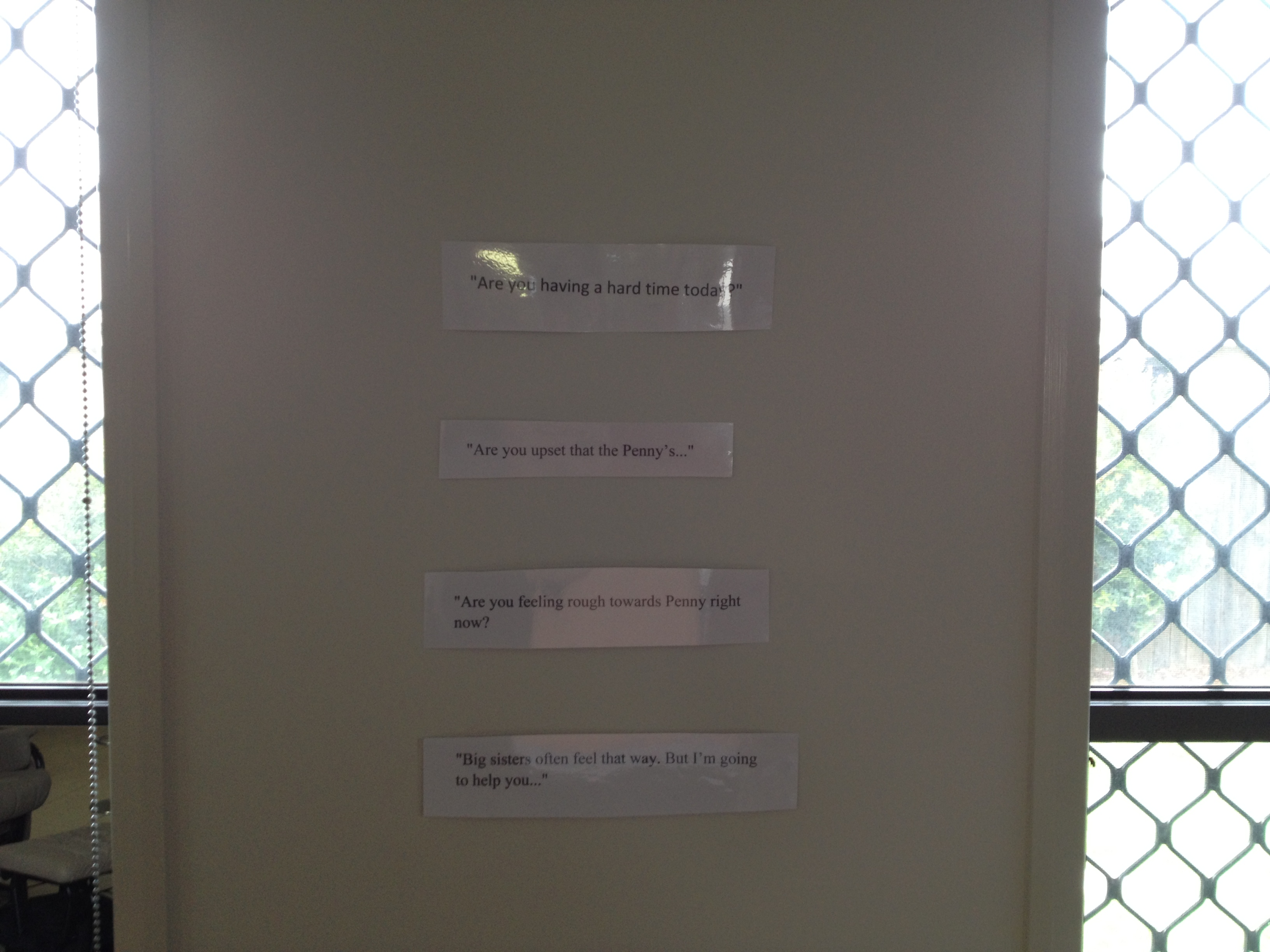
IMG_2816

Phrases read:
“Are you having a hard time today?”
“Are you upset that Penny’s…?”
“Are you feeling rough towards Penny right now?”
“Big sisters often feel that way. But I’m going to help you…”

Most of these phrases have come from Janet Lansbury’s post, Helping Kids Adjust to Life With the New Baby. I have read and reread this post several times but could never seem to get the phrases to stick in my head to use when I needed to. Now that they are up to refer to, both my husband and I can finally use them more consistently.

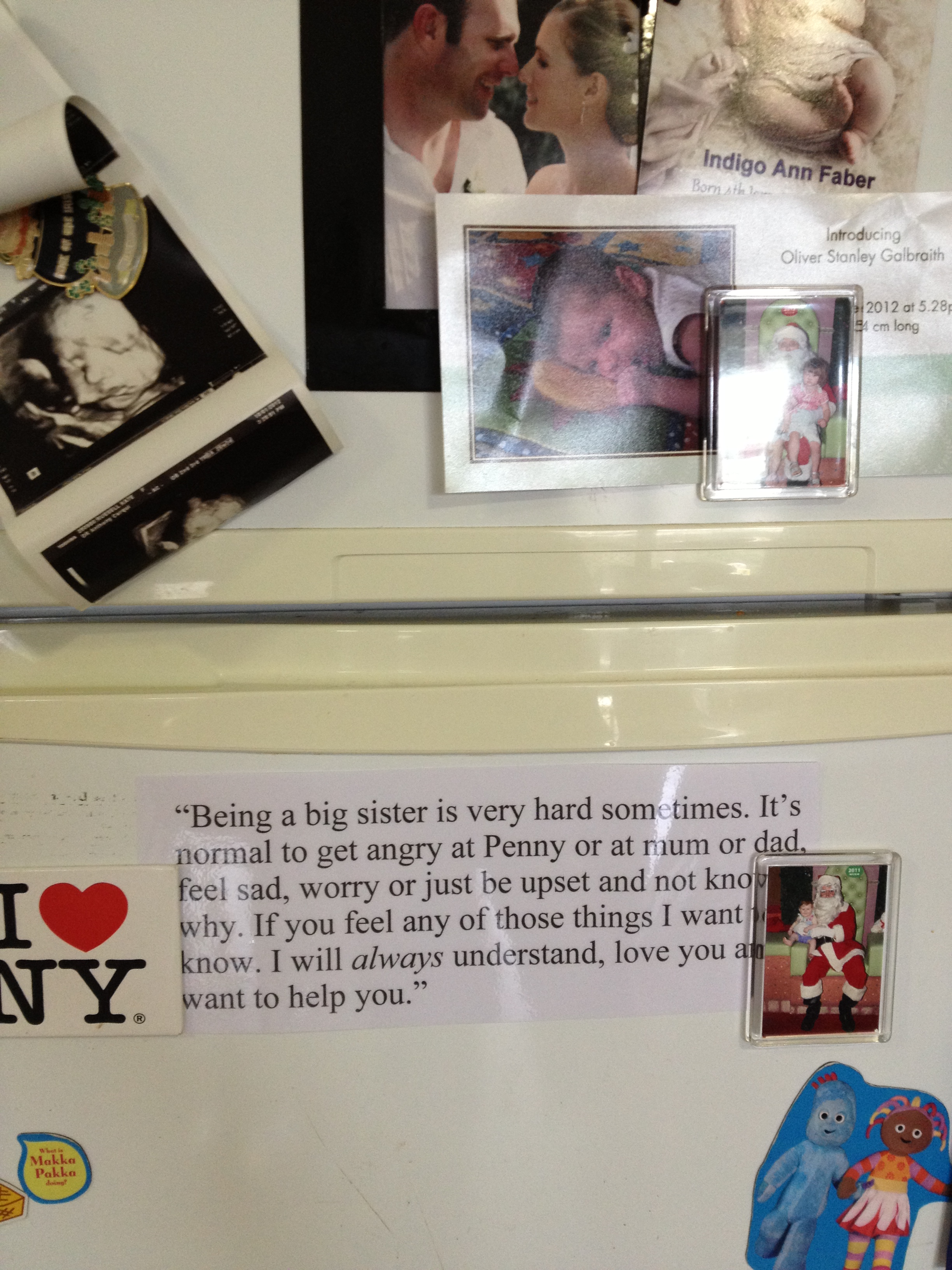
The only quote that went on the fridge was a long quote. Janet suggests talking regularly to the older child about how it can be difficult being an older sister. This way they continue to get a sense of your unwavering support and understanding of their predicament. I have placed the quote on the fridge and although wordy, I intend to use it as a reminder to talk to my eldest daughter about her feelings rather than to read it to her word for word.

IMG_2819

Quote reads:
“Being a big sister is very hard sometimes. It’s normal to get angry at Penny or at Mum or Dad, feel sad, worried or just be upset and not know why. If you feel any of those things, I want to know. I will always understand and love you and want to help you.”

What things have you done in your household to help create a united front and consistency when using the RIE approach?

Needles Don’t Have to be Traumatic for Children

When my youngest, Penny, was 4 weeks old, she developed a sudden onset left side facial paralysis. We took her to hospital as soon as we realised what was going on and were told she would need to undergo tests to determine what was causing it. They weren’t sure if she was having a stroke or whether she had a tumour or if it was Bell’s Palsy.

On the night she was admitted I watched on, sobbing as the doctors spent over 20 minutes holding Penny down, trying to insert a cannula into her arm. You see, she was well in every other way and was putting up such a fight that they kept missing the vein and having to retry it as she squirmed around under them.

Needles Don't Have to be Traumatic for Children ~ Peaceful Parents, Confident Kids Continue reading

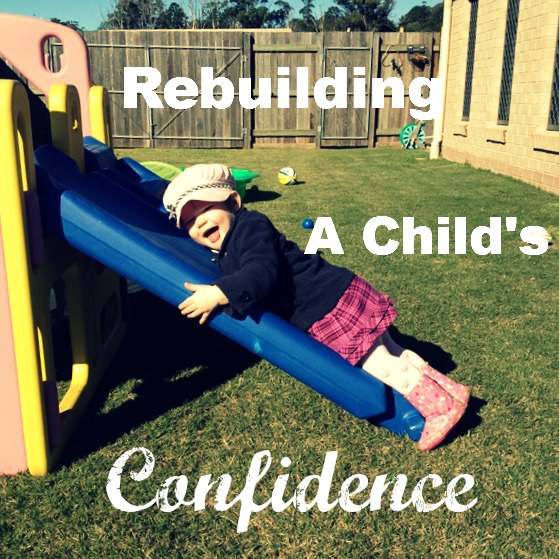
Rebuilding a Child’s Confidence

As an infant, my daughter could have been considered a very confident baby. Not a lot phased her, she rarely objected to strangers holding her and in play group settings, was very interactive with other babies and seemed happy to explore her environment with plenty of confidence to try new things. She has always displayed exceptional intelligence and physical ability and has a beautiful heart, but somewhere along the way, my little girl’s confidence has been knocked.

Rebuilding a Child's Confidence ~ Peaceful Parents, Confident Kids

No longer is she always such a happy, carefree girl, and although this shift in confidence has been gradual and is peaking just as she approaches the age of two (a tough developmental stage), I can’t help but think that maybe there were some areas of my parenting that in some way contributed to my daughter’s change of nature.

I have decided to break it up into the four areas which I think may not have been ideal for supporting the confidence she was innately born with:

1. Putting her into situations she was not ready for:

Builing a Child's Confidence ~ Peaceful Parents, Confident KidsI used to have so much fun taking my daughterto the park when she was just a small baby. She seemed to love being pushed in the swing and being slid down the slippery slide. I would also help her climb up large structures by supporting and boosting her up. Unfortunately, I didn’t realise that by putting her into situations that she could not get into herself, I was unwittingly conveying the message that her actual abilities were not good enough.

Then, it was a little like a perpetual roundabout that was difficult to get off. The more we did this, the more she wanted to do it and the more she would become frustrated when she couldn’t.

In a previous post, I spoke about my natural desire to want to see my child achieve her milestones. I would try to aide her rolling by helping her onto her tummy or back when she was clearly trying to do this herself but not quite making it. I believe this may have kick started her ‘frustration squeal’ as she learned to depend on me to get herself into positions she didn’t have the muscular control to do herself and in doing so made her question the confidence she had in her own ability to do things, as well as making her feel she was inadequate because she couldn’t do it.

The same happened when she was thinking about crawling. On hands and knees, I would gently guide her hand forward, followed by her knee to show her the motions. It wasn’t long before she realised that she couldn’t crawl by herself when she wanted to and so the screams continued.

Then came the walking and so on. To her, it seemed that what she was capable of doing in the here and now was never good enough and my pushing her into things she wasn’t ready for was only fuelling this thought.

2. Playing too well with her:

When she was younger, I loved playing with her. It was like I was reliving my own childhood. I loved to build her towers that she could knock down and then help her to build her own.

Rebuilding a Child's Confidence ~ Peaceful Parents, Confident KidsWhen we played with play dough, I would be right beside her playing too. I would make lovely shapes and figures and tell stories with them whilst my daughter looked on with her big ball of mushed play dough.

When she would colour with her pencils, I would enjoy colouring in myself, being sure to stay neatly inside the lines. Little did I realise that  by engaging with her play in this way I was undermining her confidence. She would see what I was doing and when she realised she could not do it as well as I could, she would give up.

In hindsight, she communicated this to me well before she could speak. If she was building blocks beside me and was having trouble stacking more than three blocks, whilst I was easily building a great tower she would aggressively knock both hers and mine over with a yell of frustration and move onto something else.

Her reaction with the playdough was very similar and when we would colour, if she stopped to look up at mine, she would see how neat it was and then quickly scribble over the top of it and tear her own page or throw her book on the ground. She knew there was no way she could complete the tasks to the standard she thought she had to, so she would vent her frustration and then destroy my creations, maybe trying to tell me I was expecting too much.

I was teaching her how to do things properly but I hadn’t realised that, in a child’s eyes, there is no such thing as properly until you show them there is.

3. Helping too much when frustrations set in:

It is so instinctive to want to jump to the rescue of a child who is crying out for help. It is an easy fix. You solve whatever problem is ailing them and then they’re happy, you’re happy because they’re happy and everyone can go on happily playing. Problem is, when you do this, you are giving them the message that they can’t do it on their own. Therefore, when the same or a similar situation arises, the child will continue to cry out for help, lacking their own confidence to work it out for themselves.

When I think about it, I helped my daughter from early on by handing her the toy she was searching for, just out of her reach. As she grew older I helped her with puzzles, shape sorters and other toys that required problem solving. I would unhook her pram when it got stuck on something as she pushed it in an effort to prevent her shouts of frustrations and turn her posting cards around the right way for her so she could post them into the box easily.

I thought I was helping her through her struggles; I was showing her how to do things so she would quickly learn and not have to struggle anymore. Problem was, she wasn’t given the opportunity to work things out for herself and by helping her through her frustrations, I  was conveying a message that she was incapable of doing it on her own.

4. Providing her with too many electronic toys:

Rebuilding a Child's Confidence ~ Peaceful Parents, Confident KidsComplex in their design but simple in their operation, electronic toys gave my daughter a false sense of her ability. With many of her electronic toys, she could simply press a button or pull a handle and something amazing would happen. It was so easy for her that when given an inert toy that did not have a button to push or lever to pull, she had unrealistic expectations of what should happen with these toys. When she could not get something to perform for her easily, she would give up and question her ability to work it. She had little perseverance for problem solving type toys. preferring the cheap entertainment of the flashy toys.

Where to From Now?

Following RIE philosophies, I am now in the process of re-building my daughter’s confidence. As I undertake this task, I am mindful that this is not a quick fix and will take a great deal of dedication, patience and reassurance.

I now refrain from my own desires to play with my child and when I do, I am always careful to allow her to guide the play and tell me what to do, rather than the other way around. Electronic toys are a thing of the past and she is now able to engage in skill building, problem solving and open ended toys for longer periods of time.

If she cannot climb it, jump it, get into it or on it then she doesn’t get any assistance from me other than gentle support with comments like: “I can see you’re trying really hard. It’s difficult to climb over that climbing frame. If you’d like to keep trying I will stay right beside you for support.”

By substituting the old methods for these new ones, I am slowly starting to see a return in the spirit of my little girl and I hope she will go on to climb mountains, full of confidence that she can achieve anything she sets her mind to in life.

You might also enjoy reading

Allowing Children to Play For Their Age and Stage ~ Kate Russell (Peaceful Parents, Confident Kids)

Could Young Children be Better Served by Not Teaching Them ~ Kate Russell (Peaceful Parents, Confident Kids)

Toys Fostering Creativity and independence in Children ~ Kate Russell (Peaceful Parents, Confident Kids)

Could Young Children be Better Served by Not Teaching Them?

Could Children be Better Served by Not teaching Them ~ Peaceful Parents, Confident KidsHaving been a teacher for 12 years, I had always thought I would have a distinct advantage over other parents who had not trained in this area in giving my children a leg up in their education. After all, I knew all the little tricks for learning, I knew what needed to be learned (or I thought I did) and I knew how hard it could be for a child who was behind in their work and could never seem to get on top of things. I was determined that my children would begin their schooling half-educated and ready to hit the ground running, not having to struggle through.

So after the birth of my first daughter, even though I had switched to mother mode and was to take a year’s leave from teaching, I just couldn’t quite separate my role as a teacher from that of a mother. I religiously read to my baby, showed her flashcards naming all the objects, got little foam letters for the bathtub to spell out her name, went through all the shape names as we poked them through the shape sorter and on it went. I even went so far as to order the ‘Your Baby Can Read’ program and for a little while, plonked my baby in front of it as if it would somehow miraculously teach her to read. Oh dear, how wrong I was!

I have since learned that teaching is not in the role description of a parent – at least, not explicitly. I am not employed by my babies to teach them the alphabet, maths, or even how to walk, talk or eat their food. My role is as a guide only. I am here to provide them with an environment which provides them with safety and security as well as the experiences for them to learn for themselves.

My children are best served by me sitting back and observing. Showing them how to do things instead of trusting them to work it out for themselves, insisting they point out the red sheep in the book we are reading together, involving myself in their play by showing them how tall I can build a tower of blocks or interfering in their daily struggles and challenges not only pressures them to do more and know more than they already happily do but also robs them of the opportunity to develop even more important life skills such as perseverance, hypothesising, resilience, forming conclusions, risk taking, cause and effect and the list goes on.

Like Magda Gerber once said:

“Be careful what you teach, it might interfere with what they are learning.”

A child who is not taught, gains the opportunity to experience the self-pride and confidence which comes when an achievement is made all by themselves. This can only serve to foster a lifelong love of learning which is paramount in arming our children for the lifetime of formal learning they will gain at school or in the workforce.

There is one thing we can be sure of with our children and that is that they are all born with an innate desire to learn. If I don’t show my children how to walk, will they never take those first steps in their lifetime? If I never teach my child the alphabet, does that mean they will never learn it? The thing is, a child’s desire to learn is far stronger than our need to teach and when the time is right for them, our children will seek out the knowledge they wish to continue to grow and develop at their own pace.

I have also discovered that there is nothing more joyful than watching your child persevere through frustrations, only to eventually triumph and complete the task they had set out to do. Jean Piaget wisely pointed out:

“When you teach a child something, you take away forever his chance of discovering it for himself.”

And when you see the smile light up on your little one’s face when they make the discovery or accomplish a task you will soon realise the importance of Piaget’s message. It is especially affirming when they immediately re-enact a struggle they just made it through as if to reassure themselves that they can do it and will continue to be able to do it when they need to in the future.

I now know that being present whilst my, now two, children are at play is all I need to do to ensure they learn all the vital skills they’ll need to be well-equipped for their lifetime of learning. In doing this, I also realise that they’ll actually learn far more than if I had continued to try to teach them everything at every opportunity.

IMG_2417

 
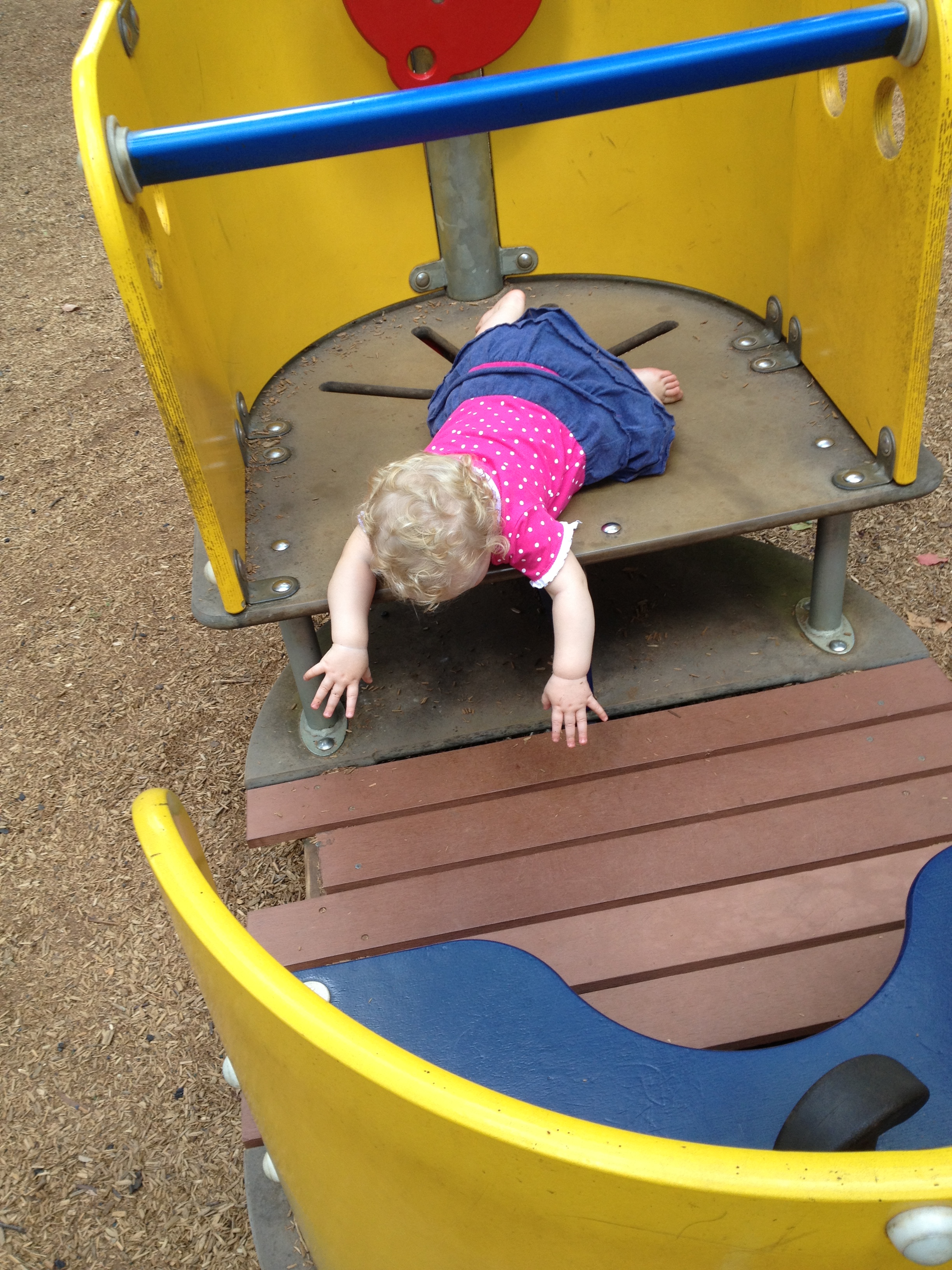
When my daughter climbed into this boat structure at the local playground earlier this week, I sat with her for nearly 20 minutes whilst she struggled to work out how to get back out. She tried going backwards and forwards on her tummy and then tried standing and holding on whist stepping down. Each time she would cry out in frustration and look to me for help. I was solid in my resolve and simply sat right near her and calmly acknowledged her frustrations and let her know that I would help her if she really needed me to. Each time I spoke this to her, she would look away from me and have another attempt. Although she was whinging, it was clear she didn’t want me to interfere. Eventually she got down by wriggling backwards feet first. It was then time to leave the park. I was back there today and you can guess where she made a beeline for when we arrived. Yep, the boat. She climbed straight up and then came straight back down, head first this time, within about 10 seconds. She then repeated this several times, alternating between going head first and feet first. Not a whinge to be heard but plenty of beaming smiles 🙂