Why I Allow my Kids to Struggle Over Toys

My daughters have always had a rather volatile relationship. Born just 13 months apart and with polar opposite personalities, they have often struggled living their daily lives in each other’s company particularly when it comes to sharing toys.
Why I Allow my Kids to Struggle Over Toys - Peaceful Parents, Confident Kids


In the beginning it was quite easy to get caught in the trap of seeing my eldest, Lucy, as the aggressor in many of their altercations (because, in reality, she was), leaving my youngest, Penny, with no choice but to be considered the victim, always having to be rescued by us.

Over time, and after learning about RIE and reading many expert articles cautioning against not only using these labels for children but also against even perceiving one child as the victim and the other as the perpetrator, we changed how we considered the children’s roles in these struggles. I have previously written about the importance of this shift in mindset and for the most part we have managed to remain neutral umpires during our children’s scuffles.

As the girls have gotten older and wiser, we have been able to enjoy more and more beautiful moments watching them play harmoniously together for extended periods of time. However, with their developing age, significant physical strength has emerged from both of them. Their previously lop-sided battles for toys that used to end quite quickly with Lucy gaining possession of the hot items, were now becoming a much more even contest involving far more drawn-out struggles.

With the drama surrounding these struggles, it can be easy, as parents, to want it ended quickly to restore peace in the house. It is tempting to step in and break up the fight, putting the toy away or giving it to its original owner. We made the decision quite some time ago to allow our children to work through these struggles in their entirety, stepping in only to prevent physical hurt from ensuing.

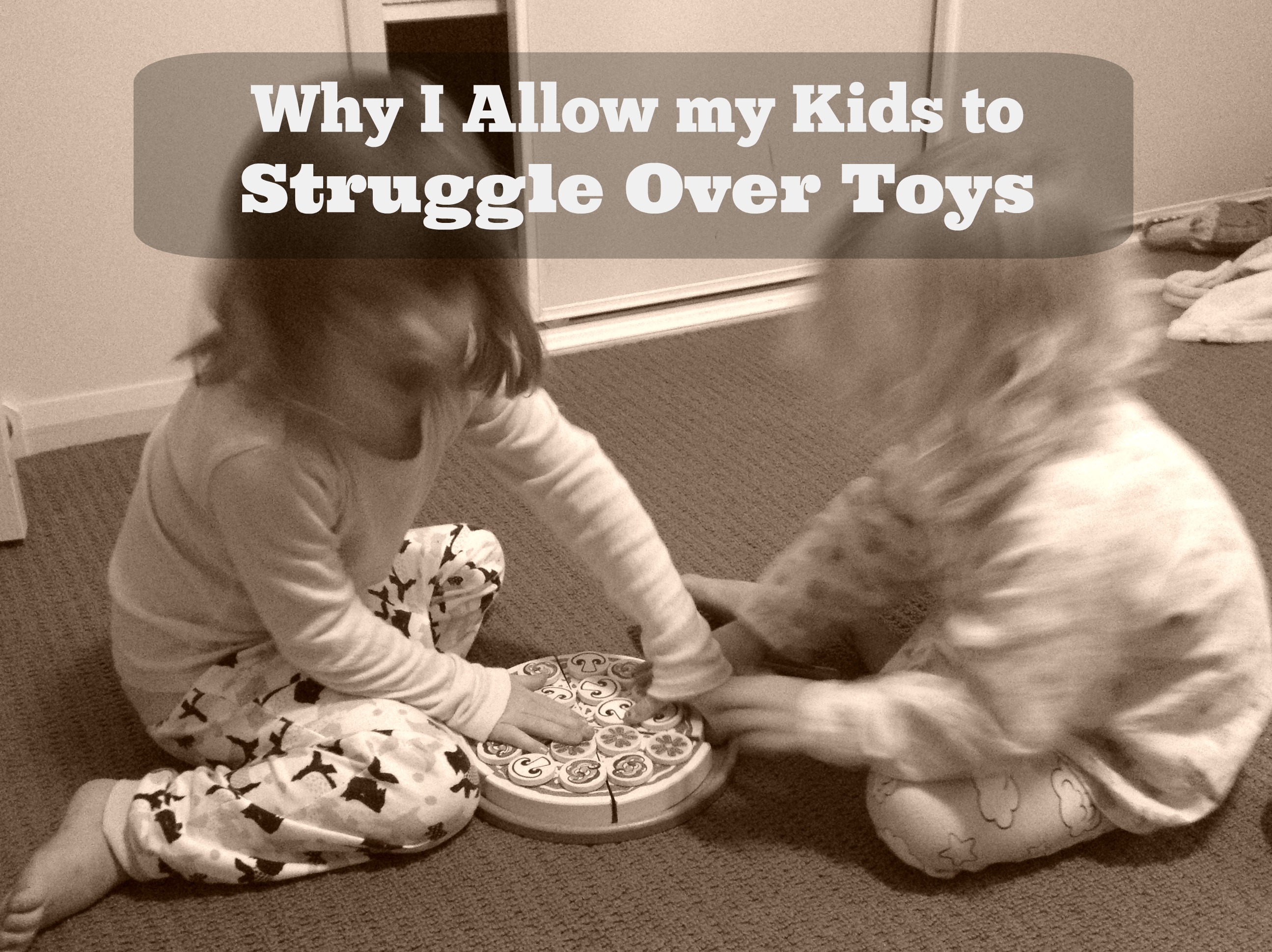
Tonight, for example, Penny (my 2.5 year old) was initiating a game of hide and seek, crawling under a table and calling out, “You can’t find me!” Whilst under the table she discovered a bead maze that her older sister had left there hours earlier. She picked it up and began playing with it whilst I proceeded to ‘try’ to find her. Hearing a game in progress, Lucy came racing in excitedly and dove under the table only to find Penny with ‘her’ toy.

Hide and seek quickly became a duel between the two as each staked their claim on the maze and fought furiously to defend it. As I crouched under the table beside them, blocking their attempts to grab each other’s hands to prize them off or push each other over, and sportscasting the event, I admired their tenacity and found myself appreciating the courage, strength and determination each of them displayed in this volatile situation.

I could see how healthy this battle was for their strength and resilience in the following ways.

It was loud. To remain assertive in a situation where someone is screaming at you from just centimetres away takes bravery.

It was physical. Gripping an item tightly for an extended period of time whilst someone struggles against you, pushing, pulling and occasionally swiping at you takes immeasurable strength and determination.

It was emotional. Feeling these emotions and conquering them takes resilience and it is liberating and empowering for young children to know they can survive these emotions and come back stronger.

It was authentic. After what seemed an eternity (probably one minute), one of the girls emerged with the item, leaving the other devastated and flailing on the floor. A short time later, that same child had picked herself up, dusted herself off and moved confidently onto a new toy. To feel genuine loss and grieve that loss only to rise again, finding contentment in another toy soon after, empowers them to cope with other forms of hurt, loss and grief they may experience in the future.

As I have come to terms with my children expressing their emotions freely after practicing Magda Gerber’s RIE parenting for nearly two years, I now feel confident to allow my girls the time and space they need to come to their own natural conclusions in their fights for a particular hot item. I am realising that despite the trauma they seem to be going through at the time, they are actually learning so many valuable skills during these scuffles. My interference would only rob them of the chance to grow from these altercations.

Toddler Toy Battles- Interventions that Work (Podcast) ~ Janet Lansbury (Janet Lansbury- Elevating Childcare)

5 Reasons to Love Conflict ~ Emily Plank – Abundant Life Children

7 Things I Should Know About Helping my Children to Share (From my Toddler Coach) Kate Russell (Peaceful Parents, Confident Kids)

 

Banana and Yoghurt Cake

Banana and Yoghurt Cake is one of my children’s favourite treats. I love the nostalgia this cake brings me and I am so excited to share the recipe with you as I step out of my comfort zone on my blog and begin what I hope will be a weekly series delivered to you on Tasty Tuesdays!

Banana and Yoghurt Cake ~ Peaceful Parents, Confident Kids

Delicious home-cooked banana and yoghurt cake.


My mother was a great cook when we were growing up and, well, she still is. She cooks real food, from the heart and seems to make even the most boring food taste like it should be in a five-star restaurant.

Everything we ate when we were children, came from our farm. Most of the ingredients she used she made from scratch. It wasn’t that my Mum was a fanatic about health (although she was conscious of eating healthily) or being a hippy, 70s parent, it was merely because my parents had very little money.

They used the space they had on the farm to grow fruit and vegetables, rear beef and chickens and milk cows. Nothing was wasted and Mum became very efficient at making ordinary, everyday ingredients into beautiful, country-cooked meals.

Now, I don’t profess to have inherited her gift with food but I have, overtime, managed to nut out some of her (and my) favourite recipes. It has been a trial as often her descriptions for recipes go something like this:

“Beat a handful of sugar and an egg together. Add a dash of milk and stir in a pound of flour” ~ Mum

Ok, Mum, so how many tablespoons of sugar would that be? Yeah, so as you can see, she’s not so great on the details but I think I have managed to get some proportions together and replicate some of her delicious meals and scrumptious baking.

I intend to share these with you for as long as I can get her to share them with me.

First up, I would like to share this delicious Banana Yoghurt Cake with you. My Mum actually dislikes Bananas a lot! But we grew them in abundance on our farm and therefore they had to be used.

So I have many fond memories of smashing up bananas whilst my mother gagged over the smell and then eating warm banana cake straight from oven. It was the only cake, Mum let us eat more than one piece of at a time because she just wanted to see it gone. I hope you enjoy it!

Banana and Yoghurt Cake

125g softened butter (free tip 1: if it is not softened it will not cream!) (free tip 2: warm the bowl and beaters with hot water before creaming if the butter is not quite soft enough)

3/4 cup castor sugar

1 egg

3/4 cup mashed banana (3 overripe bananas)

200g greek yoghurt

1 cup wholemeal self-raising flour

1 cup white self-raising flour

Grease a 15cm x 25cm loaf tin and line the bottom with the wrapper from the butter. Preheat oven to 180 degrees. Cream butter and sugar until pale and fluffy, add egg, beat until combined. Stir in banana and yoghurt then add sifted flours. Spread mixture into prepared pan and bake in oven for 1 hour or until skewer comes out clean.

(Free tip 3: check cake with a skewer when the baking aromas in the house start to intensify as this is a good sign it is nearly done. An over-cooked cake is a dry cake!)

I would love for you to take a photograph of your Tasty Tuesday Meal and share it with us all on the Peaceful Parents, Confident Kids Facebook Page with a link to the recipe or on Instagram using the hashtag #ppcktastytuesday

.


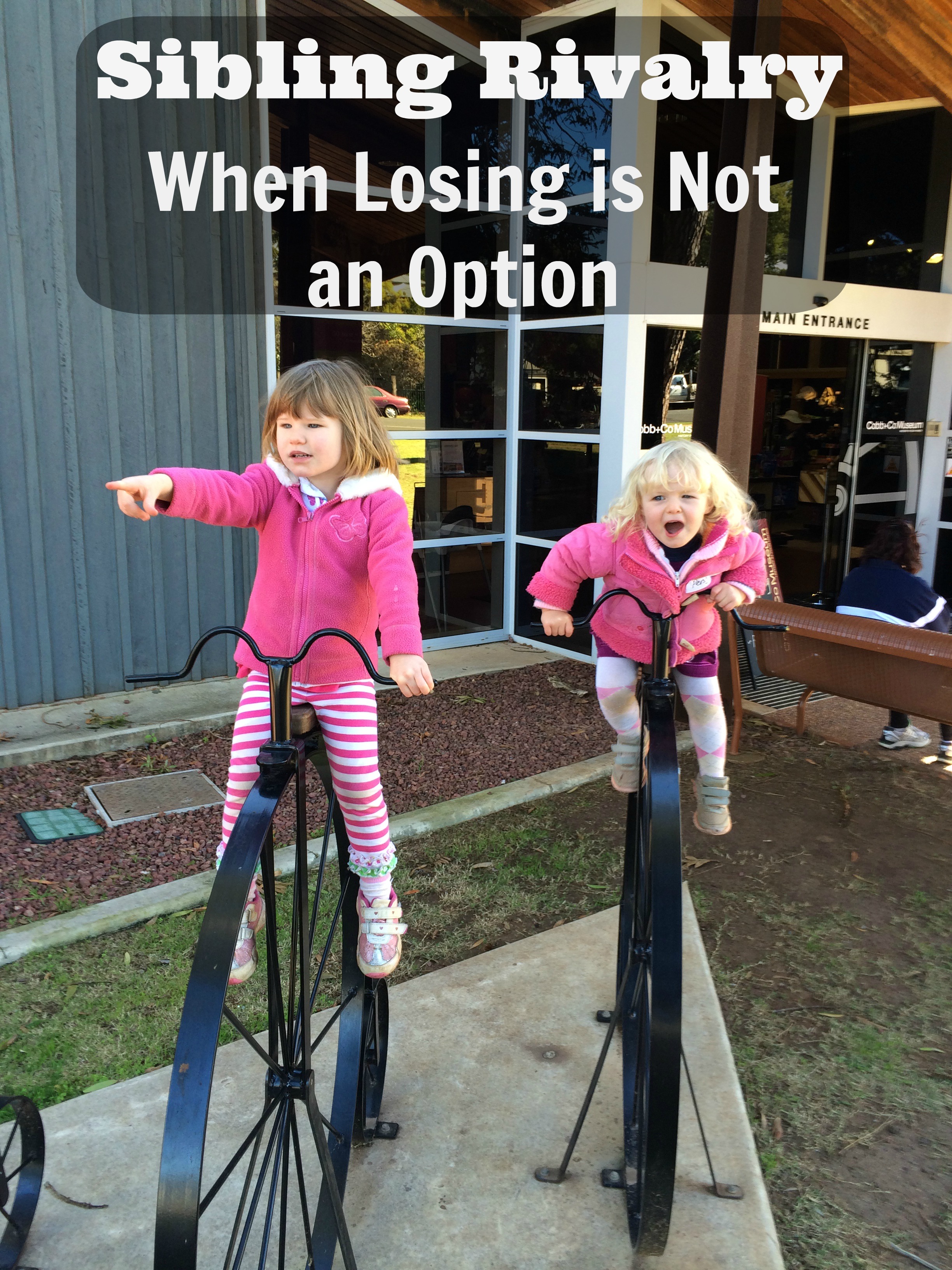
Sibling Rivalry: When Losing is Not an Option

Sibling Rivalry has taken on a new meaning in our household over the past couple of months. Our children have both nominated themselves to compete in the Russell Household Olympics, competing in events such as Who is the fastest Dresser, Who Can Get to The Front Door First, Who Gets Strapped Into Their Car Seat First, Whose Milk is Poured Quickest, and Who is the Speediest Toilet Racer.

Sibling Rivalry: When Losing is Not an Option ~ peaceful Parents, Confident Kids

Sisters engage in a competition of who can ride the fastest (on bicycle statues)

Yep, it doesn’t matter what it is, every aspect of our daily life has been turned into an Olympic event where the children genuinely feel as though they have worked their whole life leading up to that moment. It sounds great in theory, with the children moving in double time to complete tasks, we should never be late again nor lose our patience when the children take too long, but unfortunately the absolute devastation which ensues in the child that does not realise their dream of winning undermines the actual speediness of the event.

With my husband and I both being athletes and competing at high levels in Volleyball in the past, I guess it could be expected that my children would develop competitive streaks but gee whiz, we were never prepared for this. What confused us the most was that, we have consciously avoided pitting one child against the other deliberately avoiding using phrases like, “Who can get into the car first?” Or “Who can get their clothes on first?”, traditionally designed to manipulate children to move quickly through tasks.

So when my eldest daughter, Lucy, came home from care one day, stepped through the front door and turned and announced “I win!” to her bewildered sister, Penny, I wasn’t quite sure how to respond. Initially I thought I would downplay it and it would die a death along with the other “bum bum” and “poo poo head” phases previously experienced. This was made easy in the early days by the fact my youngest had no idea what her older sister was talking about and therefore, did not react.

Clearly, wanting to create a viable competition, Lucy persisted, often repeating herself to Penny in a tormenting tone “I win, Penny! Penny, I win, you lose! I beat you! Mummy, I beat her!” So whilst Penny was not sure what the words Lucy was saying meant, she started getting the feeling that whatever it was, she was coming off second best and she didn’t like it. Before long she had signed herself up for every competition going and I was unwittingly dragged in as an unpaid official.

Soon, we were being woken every morning to the sounds of “I beat you!” followed by the loser’s devastated wail of disappointment and plea against the integrity of the winners self-proclaimed victory. Akin to a world war with so much seemingly at stake for the participants, these Olympic Games were not for the faint-hearted.

As officials, my husband and I were there to ensure the safety of the competitors first and foremost and then to support the emotions of the losing competitor. This was becoming a difficult task with the meltdowns of the losing athlete taking up to an hour to dissipate. Keen to see the back of these championships, I tried a few different techniques.

At first I tried to make it stop. When I could see the children enter the starting blocks, I would be quick to let them know it was not a race and it didn’t matter who won. This did not work however, as in their minds, it was a race and boy-o-boy did it matter who won. What was I thinking? So I began to muse – how could I support my children through this phase and help them through the big feelings when they lost. I could hear my mentor Janet Lansbury in my head saying ‘Let feelings be!’ and I knew I needed to try. I needed to accept these competitions and allow them to run their course, staying unrattled about the big feelings which followed. So my attempt to do this began.

I continued to down play the competitions but used more sportscasting to help the children make sense of what was happening. When one child would announce their victory to their sibling (who was sometimes unaware they were even participating), I would say nothing unless there was persistence in the victor’s announcement or a protest by the loser in which case I would sportscast: “Lucy, you are saying that you got your cup out of the cupboard before Penny. Penny, you are upset.” Then I would acknowledge feelings for as long as I needed to.

This method helped to provide me with the unbiased words I needed to use as the children sorted through their differences and I think it gave the girls an opportunity to learn how to cope with these difficult experiences in a supportive environment, but as months went on and more and more competitions entered our day, the impact on the functioning of our daily lives was getting extreme. It seemed the children were stuck in a competitive rut, addicted to the power they felt as a winner, and my patience was wearing thin. 

This was amplified by the fact that the competitions often occurred on the way out the door with the race to get into the car seat first a hotly contested event. I was always dragged into this one because whose door was opened and whose straps were buckled first ultimately decided the winner. Then began the long-winded process to convince the losing party to also get into their seat and get their belt on.

I needed to help them realise that doing something faster, better, stronger or just first was not as important as they were imagining it to be. The victor was being afforded too much power by the reactions of the losing party and starting to seek this powerful feeling by ensuring the loser was well aware that they lost and should be feeling miserable. Their proud announcement of coming out on top was always directed straight at their competition with little regard for sportsmanship.

To help manage this uncomfortable level of power I needed to take some of the sting out of these loaded victory statements. I decided I could do this by countering the statement with a light-hearted but meaningful statement of my own. So when one of them proclaimed “I beat you/ her!” I would say “And I love you/ her” in a similar announcing type tone. They would look at me strangely and then look at the loser and repeat their words, clearly looking for the reaction. I would then repeat my statement and so on. Sometimes I would add a little rhyme, “I love you when you win and I love you when you lose, I love you in the sun and I love you in the moon.”

It has surprised me how well this method has worked. There are still races to get to the shower first, requests to pour their milk first and sprints to get to the car door first but now the fall-out is much less. The losing party is starting to realise that losing is not so bad. Nothing bad really happens and their parents love them just the same. The victor now seems far more comfortable with the power they get from winning and does not seem so caught up in displaying the unsportsmanlike behaviour of rubbing the loser’s nose in it. Sometimes I even hear my eldest respond to her sister’s victory proclamation, “I beat you!” with, “That’s ok. I love you!”

I am so pleased to see the closing ceremony for these Games in sight and in the meantime I hope my children feel more confident to cope with such adverse situations and realise the strength of their own resilience when things don’t quite go their way. They sure seem to.


Creating Bonds: Accepting A Child’s Emotions

Accepting a child’s emotions is not something that comes easily to most people. As humans we are conditioned to be comfortable with emotions such as joy, excitement and serenity. Feelings like anger, frustration, sadness and disappointment are more difficult to deal with and as such we do what we can to turn these emotions back towards the happiness end of the emotional spectrum.

Accepting a Child's Emotions ~ Peaceful Parents, Confident Kids Continue reading

Why I Yelled and Why I’m Sorry!

Today I Yelled ~ Peaceful Parents, Confident Kids

TODAY, I YELLED!

I had had an emotional morning for a variety of (non-kid related) reasons. I found myself spiraling out of control as I was dealing with poop, a child who was objecting to being cleaned and another who was struggling with my mood and being extra clingy. When my clingy daughter tried to push the other away from me as I was trying to clean up the poop, I shouted:

“JUST STOP IT!”

She immediately burst into tears and ran to her room. I let her go. I needed space but I regretted yelling at her. She was reaching out to me, wanting reassurance that I was still her rock, even when I wasn’t feeling the best.

I went to her room after I had taken a couple of minutes to regroup. I knelt down to her and opened my arms, inviting her in. As she allowed herself to be enveloped into my embrace, I apologised wholly and completely. “I am sorry I yelled at you. I shouldn’t have done that and I wish I hadn’t. It doesn’t feel nice, I know, and I want you to know that I will always be here for you and I love you very much.”

She sniffled into my shoulder as we both paused in reflection. Finally she broke the silence with a surprising, thoughtful response. “It’s a ‘liddle’ bit scary when you yell. You must have been very mad, Mummy.” Tears flowed down my cheeks and she wiped them away. “Don’t worry, Mummy, you can have some of my birthday cake!” she empathised.

How could I have yelled at this child? I know why I did but how could I?

The truth is, it wasn’t her; I wasn’t mad at her. I had failed to take care of me and had taken it out on her. Sometimes life puts us in this predicament and we find there is little relief when we need it most. These are the times our emotions sit teetering on the edge, ready to jump out at the next opportune moment.

Just as our children build up their emotions and send them hurtling out at us when they can finally hold them no longer, we too do this. The difference is, we can and should control them. Whilst we can see beyond our children’s anger and emotions and see a hurting child during their outbursts, a child can’t possibly give us the same understanding, they feel our anger, take it on board and turn from us in fear.

This is why making amends is imperative.

The rest of our day was blissful. My daughter had a new sense of calm and tolerance about her which took her right through until bedtime. Taking that little bit of time out to reconnect and reassure her revived her confidence in me and allayed her fears. This then afforded me the space I needed to work through my own issues.

Today I yelled, but tomorrow I will try not to!

You may also like to read:

Damage Limitation Following a Parental Meltdown ~ Kate Russell (Peaceful Parents, Confident Kids)

The Hard Truth About Parenting


Parenting is not for everyone but all parents are doing it. Doing it does not always mean getting it right. Getting it right does not mean life is easy and life being easy does not always mean we are getting it right. Respectful parenting is perhaps the hardest form of parenting to pull off but believing in its powers and incredible impact on children is enough to keep this mama steadfast in her quest.

The Hard Truth About Parenting ~ Peaceful Parents, Confident Kids Continue reading

Making it Through Witching Hour… Without Losing It!

Making it Through Witching Hour... Without Losing it! ~ Peaceful Parents, Confident KidsI often wonder what our neighbours think we are doing to our children as their screams echo around the walls of our house during the afternoon witching or arsenic hour as it is commonly known. As much as we thoroughly prepare for this time of the day, rarely are my children able to remain cool, calm or collected as we work towards the evening meal, bath and ultimately, bedtime. I have learned to let go of my worries about the neighbours. I know that as long as I am able to remain cool, calm and collected, my children’s emotional releases are healthy, normal and an important part of a toddler’s development.

In the past though, I would be on the phone to my husband every five minutes from about 4pm onwards, getting an update on his eta. I found the meltdowns difficult to handle and impossible to stay unruffled through. Now, I am finding a strength in my resolve to be confident, peaceful and firm during these times that I never thought I had in me. My eldest daughter put me through a pretty gruelling test recently when she melted down just before dinner. This is how I made it through unruffled.

The first and most important thing was that I was prepared. Staying calm is always hardest when you are taken off guard and caught by surprise. I knew this time was approaching, as I do everyday. I had made a batch of bolognaise sauce on the weekend which just needed heating so all I needed to do was to pop some spaghetti in some boiling water to cook. Dinner time is between 5:00 and 5:30 in our house (this is as early as we can make it usually) so as 4:30 approached and I heard intolerance build in my children’s interactions I decided to put the pot on the stove a little earlier than normal.

Sure enough, just as the water started boiling I had both children raiding the pantry for some cereal. Obviously, it was too close to dinner for more snacks so I had to get them through 10 -15 mins before I could have dinner on the table. Sending them away to play was not going to happen, so I set the timer for 10 minutes for the spaghetti to cook and gave the girls some wants nothing quality time. I took them to the lounge for some pre-dinner dancing. We turned on Pandora for some bopping music and danced together for about 5 minutes before the girls raided the puzzle drawer and settled in for some puzzle time on their own. I was able to duck away at this point to serve up the dinner and set it at the table all ready for the girls.

Tiredness overcame my eldest during dinner (as it often does). She asked for/ demanded some milk and I rephrased this for her, “May I have some milk please, Mum?” I gave her a small amount in a cup which she quickly gulped down. She whined “I want some moooore!”. I set an expectation that she eat her dinner before having more milk as I didn’t want her filling up on just milk. She repeatedly screamed for milk. Sitting by her, I acknowledged, “I hear you asking for some more milk. You may have some when you have eaten your dinner.” As her screams continued I validated her emotions “Wow! You are really upset that I am not giving you any milk. It can be hard to wait.” In my head I kept repeating to myself my mantra, “She needs me to be calm.”

She eventually calmed but wouldn’t eat. Instead she pushed the food around her plate and then eventually slid off her chair and underneath the table. I set the limit, “Lucy, you have left your chair. Are you telling me you are done with your dinner?” “NO!” came the reply as she scrambled back up. I reminded her: “I would like you to stay sitting on your chair for dinner. When you leave your chair, you are telling me you have had enough to eat so I will take your plate away.”

Lucy squirmed around on her chair for a while longer before climbing down again to retrieve a book from the bookshelf. I told her I could see she was done with her dinner and that I would remove her plate. She screamed and ran after me, clawing to have her plate back. I explained that she had left the table and her dinner was going away. I let her know it was bath time now and acknowledged, “You seem disappointed that you are not able to eat your dinner. After your bath you might feel a little more hungry and you could try again.” (I don’t always offer the eat later option but tonight I felt her emotions were getting in the way of her eating and that given some time to release these emotions, she may be able to eat more peacefully)

As I ran the waters for her bath I took some deep breaths and reminded myself how hard this was for her. I resolved to support her through it and calculated that I only had just over an hour until she would be soundly tucked up in bed and I would be able to have a much needed shower and cuppa in peace. I think of it like an hour until I clock off from work. This works for me at this time of day but I try not to count down from too early on or it can have the reverse effect!

Through Lucy’s bath, the testing behaviour continued. it was clear to me that a mixture of tiredness, hunger and possibly some pent up emotions were rendering her irrational. She asked for some blue colour in her bath which I happily obliged. However, as the blue drops landed in her bath and swirled out in spectacular patterns, she screamed, “No not blue, RED!!” I had not misheard her, she had changed her mind which is what she often does when her rational brain begins spiralling out of control. It is as though she wants to create an issue worthy of her spilling out her emotions.  This was a sure sign for me that she desperately needed help.

I acknowledged “You don’t want blue in the bath. You really want red. I can put some red in with the blue if you’d like?” But she wasn’t listening “GET THAT BLUE OUT!” Came the scream as she madly started scooping water out of the bath tub, all over the floor and me. Now soaking wet, I could feel my patience waning. I needed to get her out but I needed to do so respectfully. I blocked Lucy’s frantic hands from splashing the water and calmly explained that the water needed to stay in the bath and that I would help her by holding her hands. She fought and became very agitated with me, screaming at me to let go.

“I hear you asking me to let go. If you splash the water, you are telling me you are done having a bath and I will have to help you out.” As soon as I let go of her hands she splashed the water at me once more. I explained, “Bath time is over. I will now lift you out of the bath.” She needed me to take control and over her screams of protest I spoke to her (but really I spoke to myself). This was how I was going to stay calm. “You are tired and hungry. You are having a hard time making decisions so I am going to help you by taking charge. It is so hard for you in afternoons sometimes but I want you to know that I am here for you and I want to help you. I will keep you safe.”

Now I don’t know how much she took in but saying these things definitely allowed me to keep a compassionate, confident demeanour which is what she desperately needed. This would have given her a sense of relief in my ability to parent her even when the going got tough.

I wrapped her in a towel and carried her to her bedroom. Here she was in a safe space where we could both sit and she could freely express the emotions that were taking over her little body. It wasn’t long before her wails of anger turned to healing sobs as the cortisol flushing through her body dissipated. Finally these turned to relieved sniffles. She crawled into my lap and physically relaxed as I stroked her back and told her I loved her and would always do so. She became so still that I thought she was falling asleep right then and there but eventually a little voice squeaked, “I’m hungry. Could I please have my dinner now?” I replied, “Sure, let’s get dressed.” She willingly did so and then went to eat her dinner with her Father who had by then arrived home.

When she finished she announced that she would like to go to bed (an hour earlier than her usual 7:00 bed time) so we took her to bed and she drifted off happily as I read to her.

I breathed a deep sigh of relief as I put the kettle on and slumped into the lounge chair. I listened as my husband read stories to my youngest in her room and quietly praised myself for helping a child work through her despair with the kindness and empathy that I am starting to see reflected in her own behaviours more and more.

Tantrums and Meltdowns – My Tips For Staying Calm When the Kids Aren’t – Janet Lansbury (Janet Lansbury – Elevating Childcare)

9 Best Ways to Stay (Mostly) Unruffled With Toddlers – Janet Lansbury (Janet Lansbury – Elevating Childcare)

5 Tips For Staying Calm With Children – Kate Russell (Peaceful Parents, Confident Kids)



5 Steps to a Peaceful Day Care Drop Off

day care drop off 3

Recently, Miss 3 has begun to demonstrate significant separation anxiety at her day care drop offs. She becomes clingy, and desperately upset when I tell her I am leaving for work.

I know this type of separation anxiety is extremely common and although difficult to experience, I have taken some comfort in the fact that she genuinely feels she needs me and would rather be with me than in the care of others.

I also know, however, that I need to help more with her transition into care. It has been getting increasingly more difficult for me to get away on time and her stress levels must also be through the roof. Continue reading