Finding a Peaceful Way to Prepare Dinner

Having dinner on the table in time to ward off the hunger grizzles at about 5:30pm is something I usually find quite stressful. Normally, I try to get as much done at midday when my youngest sleeps and my eldest is in her room for quiet time. Unfortunately, quiet time has not been going so well recently so I have been resorting to the TV to try to get this job done. I pre record an episode of Play School and allow Lucy to watch it whilst I prepare the evening meal and get a couple of other things done.

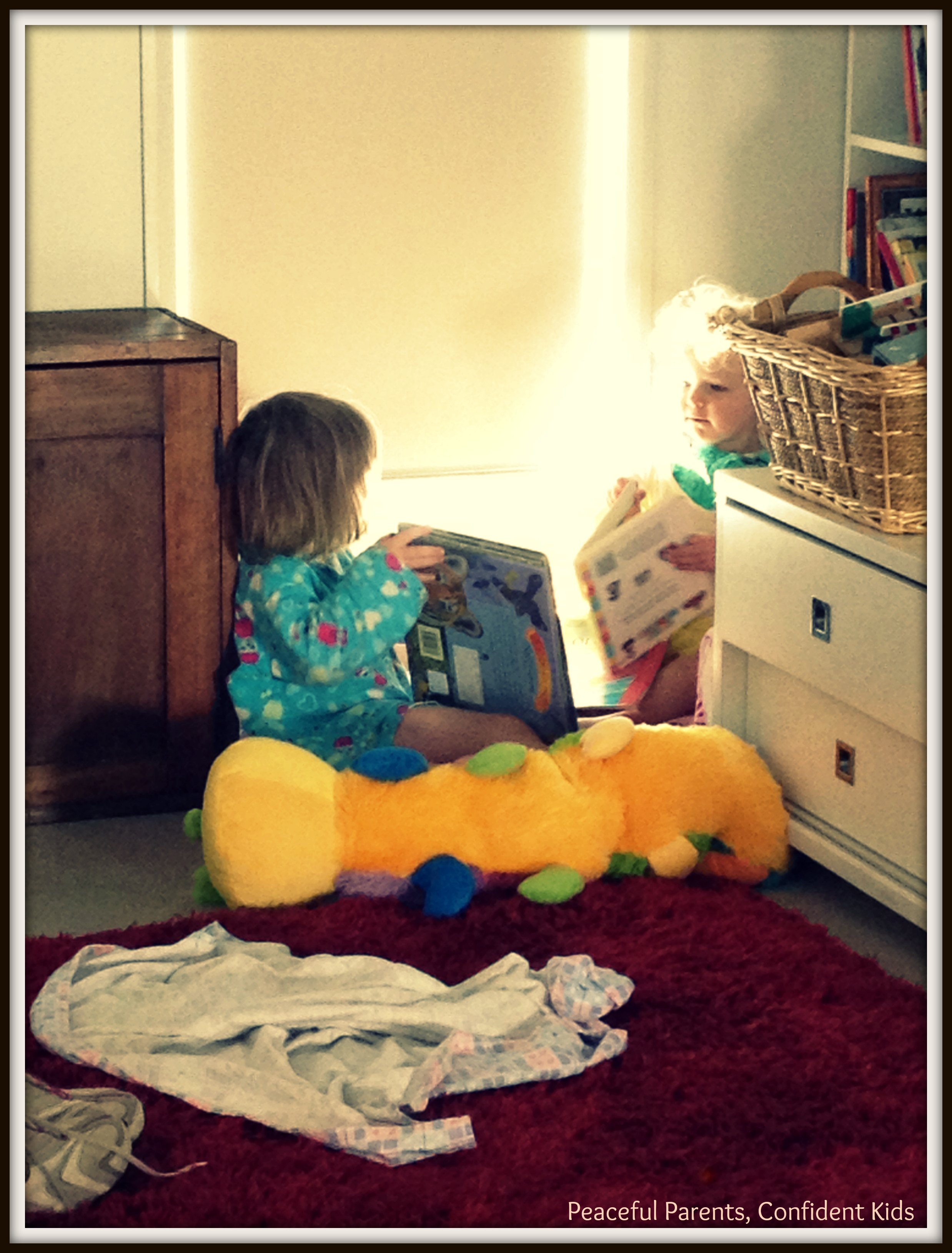
I have always tried to limit the amount of television the kids are exposed to, therefore, this habit is something I am not entirely comfortable with. So today I decided to try a new tact for getting the dinner done. It came on a whim actually as I saw the children were sharing a rare moment of cooperative reading in the corner as I was clearing the breakfast dishes. I had finished what I was doing and as I watched them play happily together I realised I had a little more time up my sleeves.
Finding a Peaceful way to Prepare Dinner - Peaceful Parents, Confident Kids

So I got all the ingredients out of the fridge to make a Bolognese sauce. That was as far as I got before my two and a half year old came bounding in with a ‘What you making?” At this point I had several options. I could have:

1. packed everything away and waited for the midday rest.

2. Set the girls up with a different task to keep them occupied whilst I hurriedly finished or,

3. Involved them in the process of making dinner. I have actually done this in the past but not usually with both children.

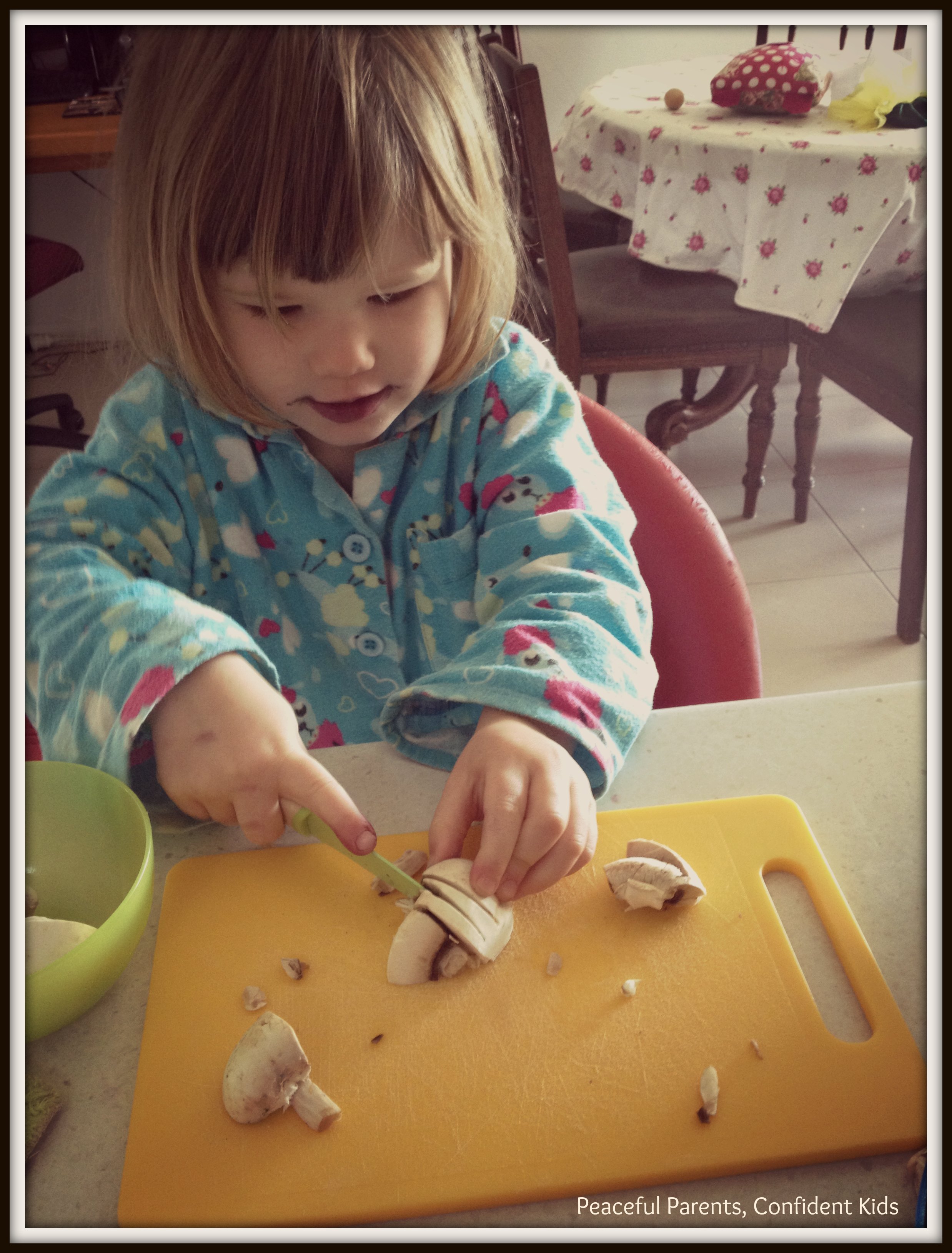
So I told Lucy what I was making and then asked if she would like to help. Of course she did so I set her a task of chopping the mushrooms which she did with great concentration.
Finding a Peaceful Way to Prepare Dinner - Peaceful Parents, Confident Kids

Once she had done this, I charged her with peeling the onion. This is a great one for her as it involves removing (hence destroying) the skin and dumping it in a bowl.
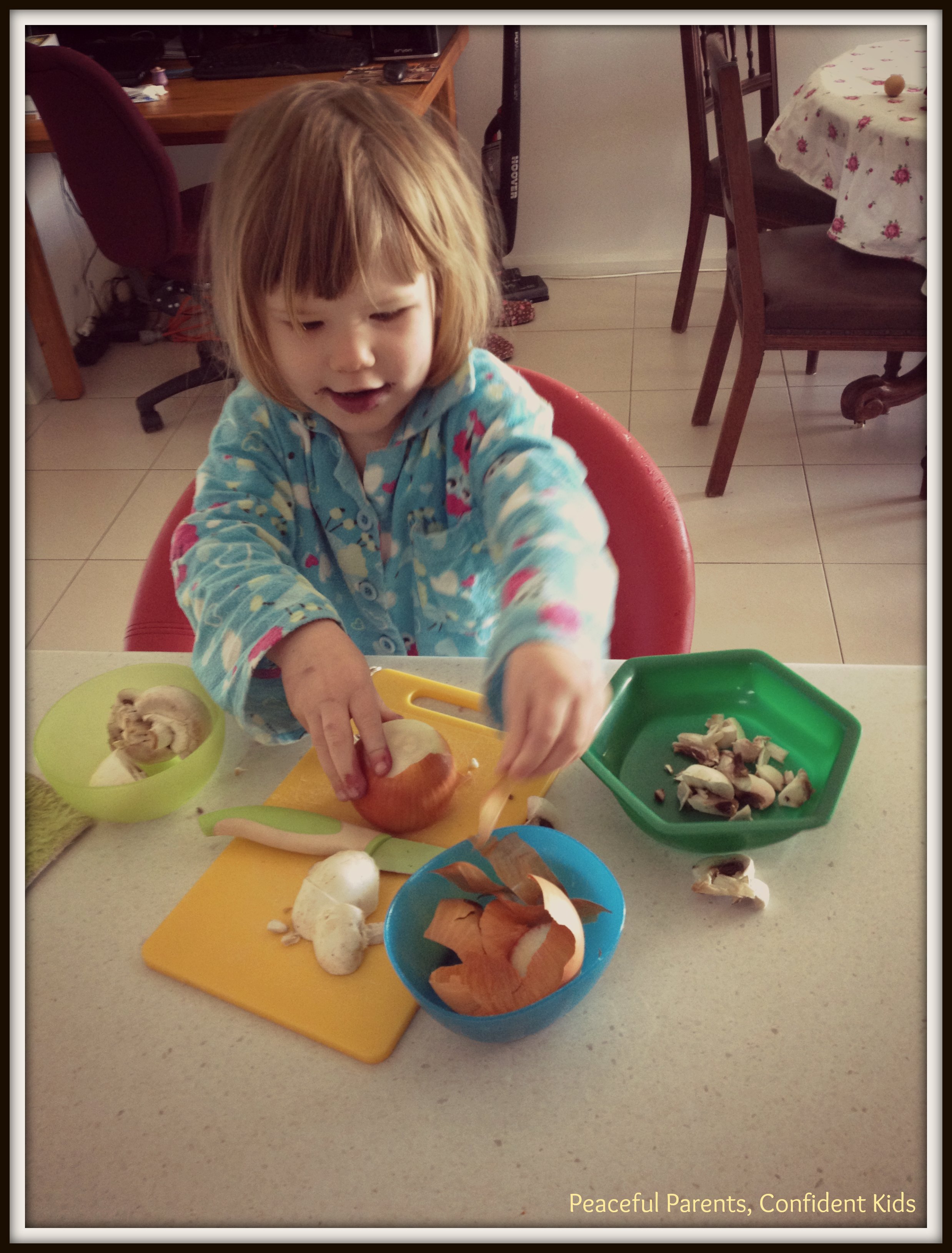
Finding a Peaceful Way to Prepare Dinner - Peaceful Parents, Confident Kids

At this point Penny (eighteen months) sauntered in. I had run out of child friendly jobs to do so I asked her to choose a saucepan out of the drawer and hand it to me. She did this eagerly and before long I had three saucepans lining the bench. I handed one back to her explaining that we only needed two. As she was taking it back to the drawer she set it down on the floor, lifted the lid and placed her apple in it. She was clearly imitating the cooking process so I handed her a wooden spoon so she could ‘work’ along side me.

Once Lucy had finished the onion peeling, she grabbed the bowl of discarded peel and climbed down to Penny, adding the peel to her saucepan. This began an all-consuming process for the two of them, creating their own dinner (a stew of sorts). They used all the scraps from my chopping as well as a few bits and pieces they had found on the floor (leftover toast scraps from breakfast – nice cleaning strategy haha!). They worked together contently, stirring, combining, putting the lid on and off.
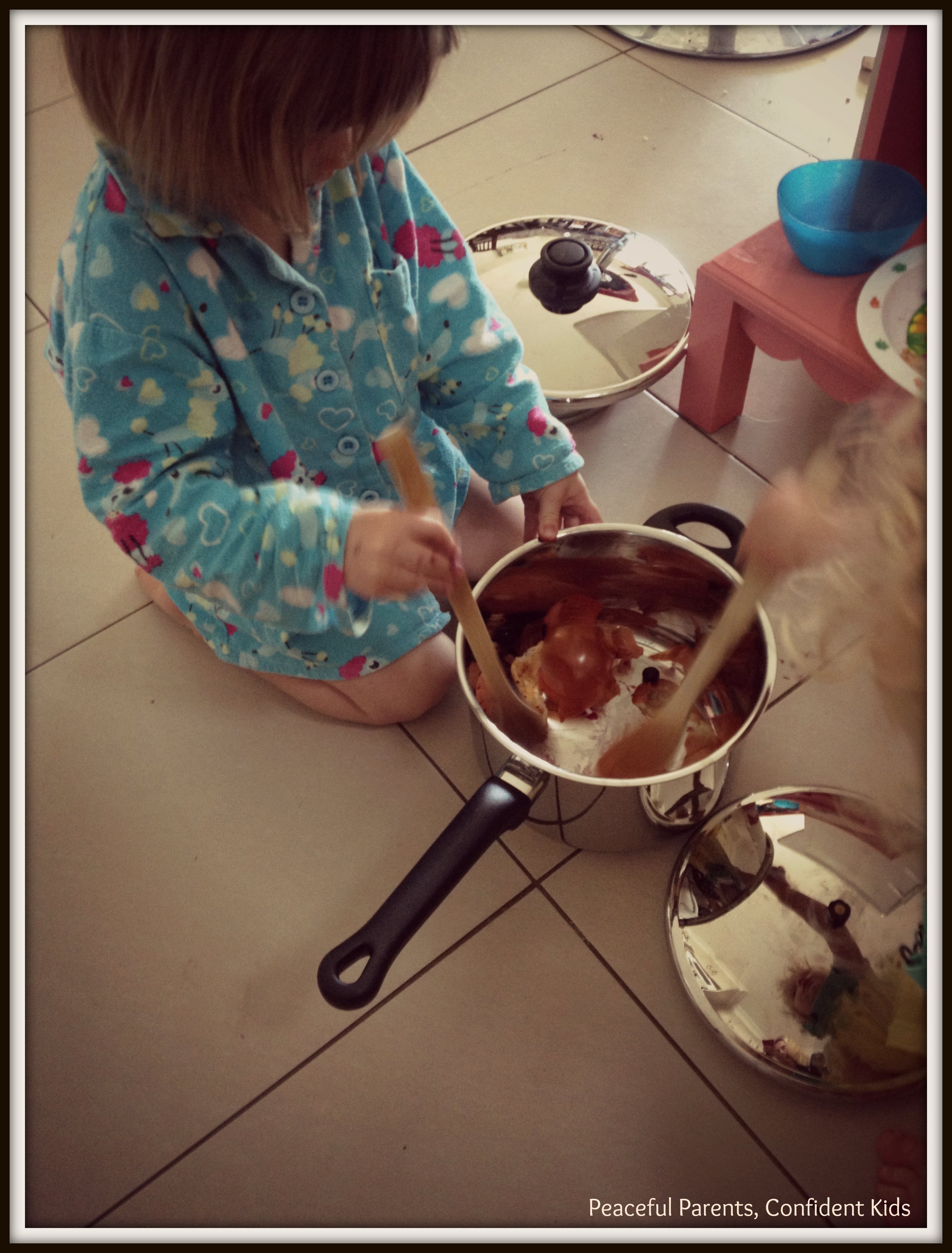
Finding a Peaceful Way to Prepare Dinner - Peaceful Parents, Confident Kids

Lucy even pinched some of my parsley and began chopping it into the pan.
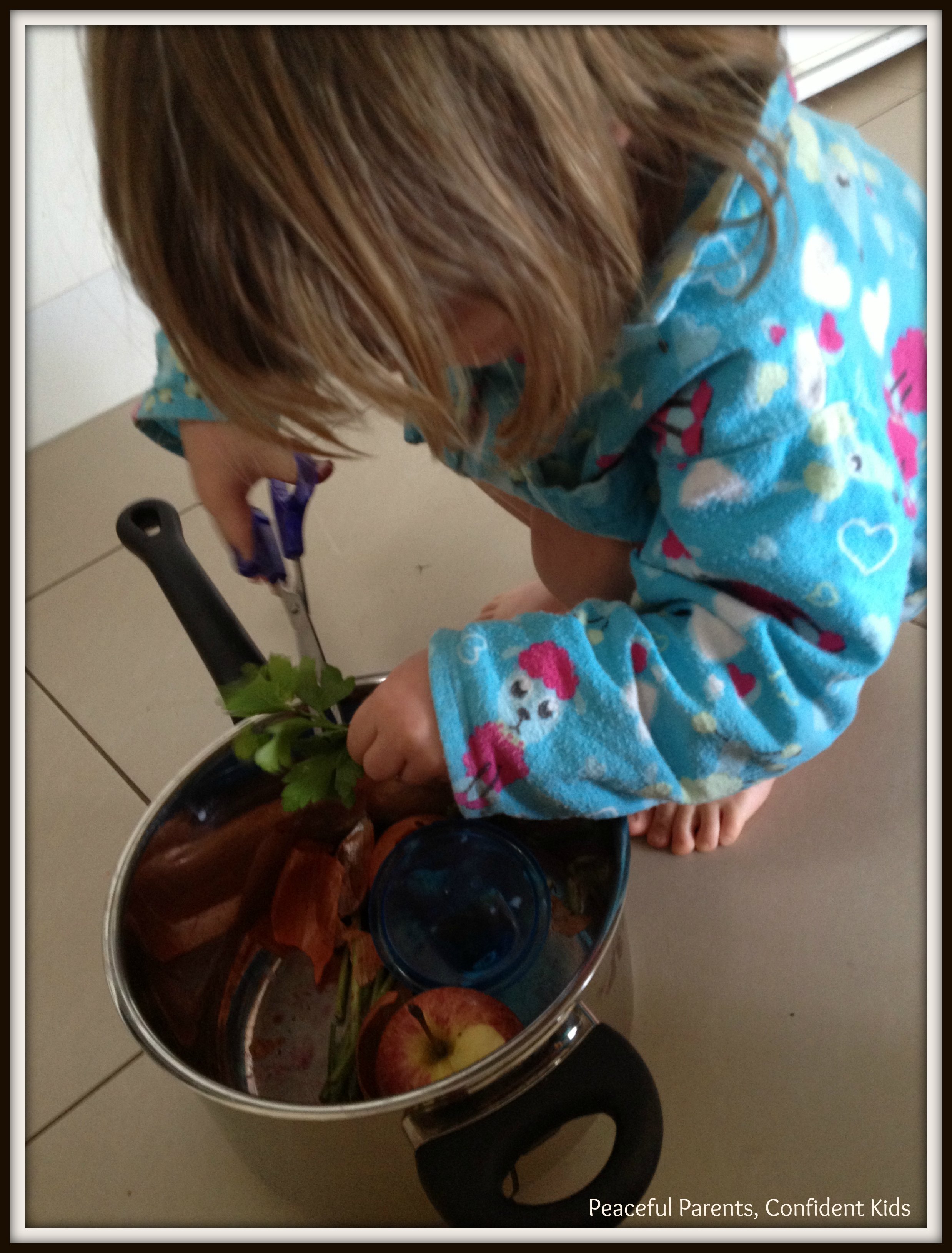
Finding a Peaceful Way to Prepare Dinner - Peaceful Parents, Confident Kids

They were so occupied by their cooking that I was able to complete the dinner and have it set aside for the evening’s meal long before they had finished with theirs. Once they were done they grabbed some of the empty bowls from the bench and proceeded to dish up the delicious meal and sit together to enjoy it.
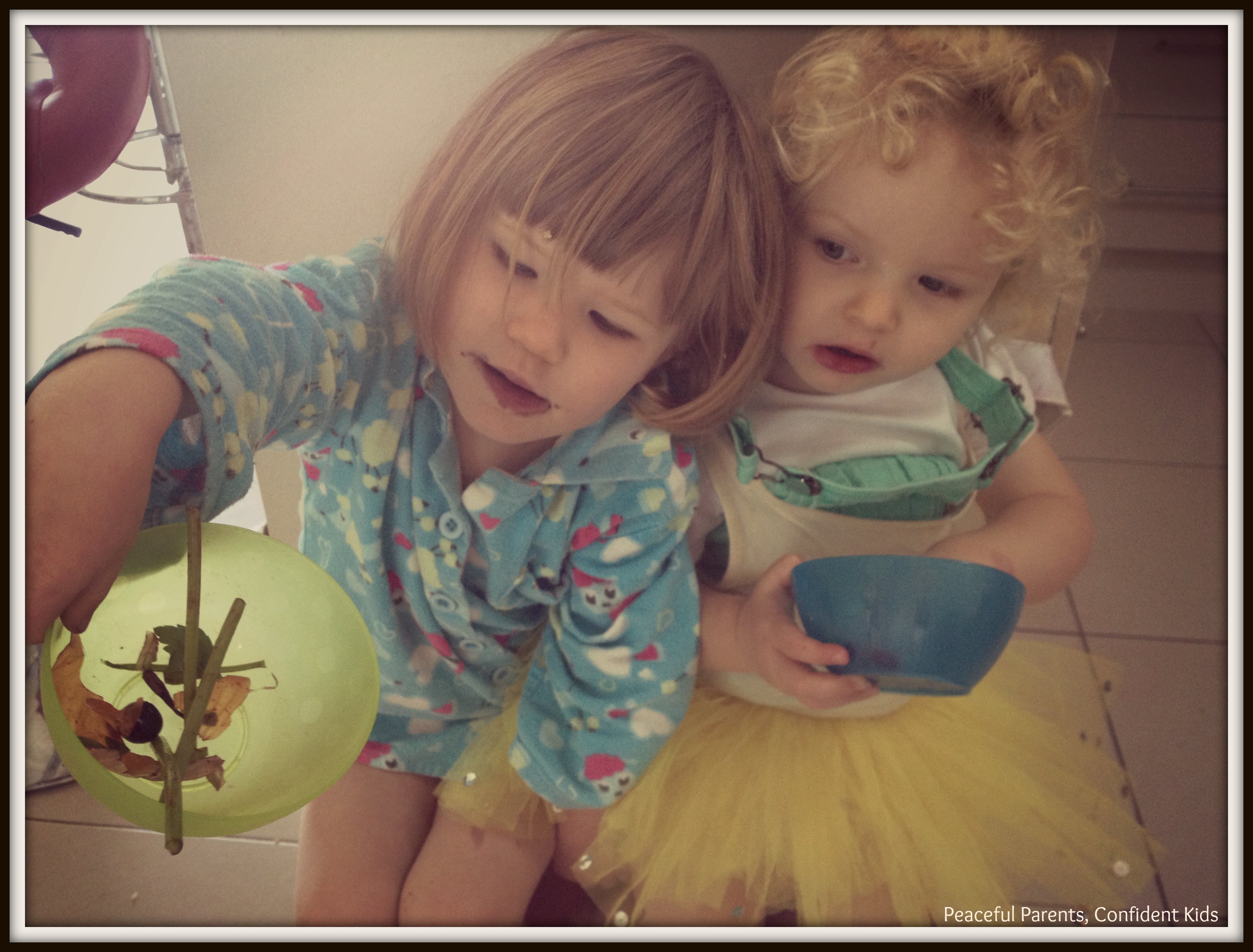
Finding a Peaceful Way to Prepare Dinner - Peaceful Parents, Confident Kids

Now, of course I don’t expect this to happen every day, but it has made me realise that getting the dinner done means picking the right time in the day in which to do it. The children are infinitely better in the mornings so I intend to see whether I can wait for a time when they are playing independently to begin the dinner process and then ensure I set aside the easier jobs for them when they inevitably come to help me. Hopefully this way I will break the habit of using the television to babysit them so I can get this job done.

Children love to be involved in the daily chores. I have learned that if I set aside plenty of time for them to be done (ie. limit the number and length of outings in the day and be somewhat organised), I can work patiently alongside my children as they learn life skills and gain satisfaction through diligent focus in the process.

For more reading on involving your children in your household chores you might like to visit these posts:

10 fun chores kids love – Kidspot (Kate@AnEverydayStory)

The Worried Cheese – Preparing Snacks at 21 Months ~ An Everyday Story

I Have a Daughter With Extreme Emotions

I have a daughter with extreme emotions…

She is strong but she is sensitive. Her emotions are bold and bright and always simmer close to the surface, ready to boil over at the slightest indiscretion. I have written about my daughter’s emotions in the past, but as i sit here once again penning my thoughts on this phenomenon which seems to occupy much of our day, I wonder if I do enough for my daughter.

I Have a Daughter With Intense Emotions ~ Peaceful Parents, Confident Kids Continue reading

Coping With a Limit Tester

“Knowing when to give infants freedom and when to introduce limits is most important and is the backbone of RIE”  ~Magda Gerber

My two and a half year old is the ultimate limit tester. Her desire to be in control is so strong that it is quite rare to have her willingly cooperate for even the most simple of requests. ‘Lucy, in two minutes we are going to get dressed.’ ‘No, don’t want to!’ comes the reply. ‘It’s time to hop in the car, Lucy.’ Lucy responds by jumping on her trike and riding away down the footpath. ‘I won’t let you play with your food, Lucy’. Another forkful gets transferred into her drink cup.

Coping With a Limit Tester Continue reading

The Secret’s to Successfully Sportscasting my Children’s Squabbles

If someone told you that they had a magic cure that would end all sibling rivalry for good, I’m sure you would pay good money to be let in on that secret. Living with siblings who squabble, bicker, fight, torment and harass each other regularly throughout the day can be incredibly draining.

Unfortunately, this magic cure does not exist but there is a sure fire way to reduce the mental fatigue associated with fighting children. This strategy not only empowers children to learn from their arguments but also provides them with the opportunity to develop the skills that will enable them to negotiate through squabbles, themselves.

sportscasting 4
Continue reading

Using ‘Provocations’ to Extend an Interest

A while back I posted a ‘play series’ which featured snippets of my girls playing with a variety of invitations as well as some naturally occurring play moments. I also featured a post explaining how I sometimes struggle to encourage my eldest daughter, Lucy, (2.5 years) to play independently and contentedly and how I hoped to use her own genuine interests to encourage more depth in her play.

I have since come to realise that I was perhaps setting up too many of these invitations / provocations and my children were coming to rely on having something different and interesting to explore on a daily basis. So I have recently got back to basics. I have not presented my children with a single provocation for nearly two months and instead have allowed them to engage and create with the lovely toys and objects we have around the house. It has been fascinating to watch them progress through these months. Initially, it was quite difficult for all of us. There was a lot of leg hugging and Lucy was far from independent in her play. It was like she had forgotten how to be happy just being. No stimulation or explorations to discover, it was all up to her how she occupied herself in her free time (which is most of the time). Gradually she has become more imaginative in her play and furthermore she seeks to include her younger sister more readily in her made up games which regularly include ‘going shopping for groceries’, playing shops (with imaginary customers) and making beds for all her little pot people and tucking them in to sleep. They still paint and craft but it has to be their idea not something I have provided for them to run with.

Now, whilst it was a successful break from offering engaging activities, I do still see value in using these invitations when I see an opportunity to extend an interest. As Lucy gets older I am seeing more and more inquiry coming into her vocabulary. Why do we have to sift the flour before we add it to the mixture? When will the leaves fall off the trees again? What do the kangaroos eat in the desert? etc. I love that she inquires about these things as it gives me a little insight into her mind. What she’s thinking about, where she’s at cognitively etc. It is from these inquisitions that I intend to set up opportunities for her to delve deeper and discover a little more about the concept. I am hoping it will allow her to develop the skills of research and experimentation to make her own conclusions rather than relying on me for the answers (some of which I don’t actually know)!

So recently we began participating in our local shopping centre promotion whereby they are giving away Australian Animal Collector Cards. We purchased the Collector’s Album for a token amount and have been busily adding the cards to it. It has been a fantastic project. Lucy has been exposed to numbers up to 100 as each card has a unique number and its own designated pocket identifiable by the number. Initially I was reading out the number and then turning to the correct pocket for Lucy to feed it in. Now, Lucy has begun matching the numbers herself once I have turned to the correct page. She gets rather upset if I try to show her where it goes. She’s even started to work out that all the cards that go together on the same page have the same coloured border around them and is having a go at finding the right page now as well.

The pages are categorised by habitats. There are rainforest animals, backyard animals, wetlands animals, reef animals, desert animals and quite a few others. Lucy was particularly interested in the desert animals. There was a Red Kangaroo card in this section and she has recently been to an animal sanctuary and fed kangaroos as well as many other beautiful Australian animals. She asked what a desert was and we flicked between pictures of a rainforest habitat and a desert one. She noticed the difference in colours between the vibrant green of the forest and the rusty red of the desert. She wondered what the kangaroos ate because there is very little vegetation. This was a really nice moment and overall I have been really impressed with the longevity of her interest in continuing to add cards to her folder every time I come home from a grocery shop.

I decided to extend her interest a little further and attempt to set up a mini habitat sensory pit representing a desert. I buried some of the desert animal cards in the pit for the girls to find and then left it to them.

IMG_5123

I used a variety of pulses (dried mixed beans, dried peas, pearl barley and rice) most of which had been sitting in the pantry for years begging to be used. I wish I knew how!! Funnily enough, Lucy has enjoyed crunching on the dried kidney beans occasionally as she plays which is fine by me.

IMG_5126

The girls loved pulling the cards out and finding out what animals were hiding out in their desert. After the pit had been up for a few days Lucy even started putting them back ‘underground’ when the sun was shining on the pit so they didn’t get burnt!

IMG_5137

Of course it didn’t take long for the sensory nature of the pit to become the focus for the play as spoons, cups and even a little bit of water was added to the activity.

IMG_5142

It has ended up being a lovely (on going) inquiry with much discovery about the desert habitat. When it loses its appeal, I will attempt to create a new habitat from the folder. I can’t wait to see how the girls react to it.

Has anyone else been collecting these cards? How have your children engaged with them?

You might also be interested in reading

Our Weekly Play: Week One

Our Weekly Play: Week Two

Setting up a Reggio-inspired Activity From Kate @ An Everyday Story

Respectful Parenting is Not Always Easiest

RIE parenting lesson

For some time now I have been going against my own instincts and the advice of many friends, families and experts and instead following the path of RIE parenting. I firmly believe that the studies Magda Gerber conducted late last century were insightful, accurate and most importantly helpful to parents wanting to treat their children respectfully. By choosing this method of child rearing, I am confident that my husband and I are empowering our children whilst building a long-lasting, trusting and loving relationship with them.

In saying this, it has not been an easy road. This form of parenting is deliberate. It’s thoughtful. It requires constant self-reflection, patience and trust. It takes a lot of energy and mental effort to challenge your own instincts and go against the only real experience you can draw on when parenting, your own parent’s methods. This coupled with the fact that many of the techniques and philosophies proposed by Magda are completely opposite to the mainstream advice given or demonstrated on a daily basis through friends, family, acquaintances, mother’s groups and experts, ensures that it is quite easy to be discouraged.

As I watch children being helped to play, made to share, stuck in time out, assisted to develop milestones and picked up suddenly without warning I often wonder why is it me that attracts strange looks and even judgements when I do things differently.  Every now and then, however, I get this little niggle of doubt creep over me. I sometimes look at my children and think, if I am doing things so respectfully; if I’m communicating with my children and acknowledging their feelings and trusting them to learn in their own way and in their own time, then why are they still screaming, using rough behaviour and throwing tantrums? In all the social circles I mix, I have only one or two friends who have joined me in parts on this RIE journey and it seems as though among all my other friends very few of them have trouble with their children testing limits, expressing extreme emotion or following instructions. This has had me seriously questioning the parenting path I have chosen and made me wonder if RIE was really the right choice for our highly spirited toddler in particular.

Then something occurred to me, I have read countless articles as well as comments from parents and experts in RIE circles who speak about their children taking longer to crawl, walk, talk, say please, thank you, hi and goodbye etc because they have been allowed to work through these developments at their own pace through supportive rather than expectant parenting. Part of the RIE philosophy is trusting that our children are capable beings and will develop the skills they need in their own pace and at their own time. By not showing them how to do things, sure, they may take a little longer but along the way they will develop vital other skills such as independence, perseverance and problem solving and once they have achieved their goal, they have done so much more completely and authentically than had they been pushed to do so through assistive techniques. So it got me wondering whether it is the same for behaviours as it is for developmental milestones?

My 2.5 year old was introduced to RIE parenting quite late in the piece and well after her younger sibling bounded into her world taking with her her former peaceful life where sharing wasn’t necessary, parents were at her beck and call and her life was content. She struggled significantly in those early days with extreme emotion, disruptive sleep and limit testing. This is what encouraged me to seek help and led to my discovery of RIE. Upon absorbing everything we possibly could about parenting respectfully, we noticed a distinct lack of punitive discipline. So for the past twelve months, the girls have had limits set through the use of natural consequences balanced with a respect for their autonomy. They have been trusted to sort through their sibling struggles in their own way and time through neutral sportscasting and again trust and they have been encouraged to express unpleasant emotions as and when they need to. When my husband and I made the conscious decision to adopt this style of discipline, it never occurred to us that we might still be dealing with some of these problems a year later.

When I look at other children and consider their politeness, their obedience and their lack of regularly expressed emotion I can’t help but wonder is it genetics? Were we always destined to parent strong-willed children or has it got something to do with the parenting style we have chosen. Now I know this doesn’t sound like a great plug for the parenting method I have been passionately blogging about for 7 months but when I stop to consider the alternative we had at the time, I have to trust that we have made the right choice. I know I could make my daughter stop taking toys from her sister by sending her to time out. I am sure she would no longer be rough towards her if I smacked her as a consequence a couple of times. Using fear as a way to change a child’s unwanted behaviour can certainly be effective in providing that outcome. I could send my daughter to her room every time she tantrumed or needed to express emotion and I’m sure after a time she would learn to kerb those emotions and keep them to herself. I could insist she says please before I hand her her food and take it away again if she refuses to say thank you. She would no doubt learn quickly to say these words that mean nothing to her but everything to society. I could certainly make our lives much more serene here by parenting in a more mainstream way and maybe my children would seem more respectful and obedient and probably happy on the surface but that’s not what we signed up for.

I have realised that trusting a child to learn right from wrong through limit setting and modelling, without the use of punishment, means accepting that they may need more time to internalise appropriate and acceptable behaviour. The mantra I repeat regularly when I need reassurance of this is that the difficult behaviours being displayed now are not going to exist when my children are 21 years old. In fact I often say this when I am questioned about not enforcing manners or greetings. I am confident of the fact that my 21 year old daughters will use appropriate manners and greet people as necessary. I know they will not scream and yell and throw themselves to the ground when they don’t get their own way and I am sure they will ‘play’ nicely with their friends too. I certainly hope they will achieve these things well before they are 21 but that is the age that I picture them setting sail from my parenting and casting off into their own lives. By then I should have done all I can to prepare them for all life will throw at them.

So I am going to ride out this difficult time. I am not going to resort to using punishments that whilst more effective and quicker in the short term, could threaten to undermine my child’s confidence or demolish our trusting relationship. I’m not going to insist my children stop crying or screaming just to keep the peace. I value emotional welfare and I have seen first hand the effects of stifling children’s emotions and not supporting them when they are at their most vulnerable. I am not going to enforce social niceties just so my children don’t seem rude to others. Both of my children often now say please, thank you and sorry of their own accord and it is so much more joyful to hear then had I insisted it be said because I know they mean it and are beginning to be guided through our modelling. As for the limit testing, well I am learning that my eldest toddler seeks to push the boundaries whenever she can see a crack. It is my job to close that crack before she is able to push her way through. As I close one crack, she inevitably finds another one but I will be there to ensure that she is kept safely from making it through each one.

For more reading on respectful parenting head to these wonderful sites:

Janet Lansbury – Elevating Childcare ~ http://www.janetlansbury.com/

Lisa Sunbury – Regarding Baby ~ http://www.regardingbaby.org/blog/

Dr Laura Markham – Aha Parenting ~ http://www.ahaparenting.com/_blog/parenting_blog

Why I Don’t Call My Daughter Shy

Shyness is something that has followed me around since my early childhood. I remember vividly hiding behind my mother’s legs during greetings and had a really hard time of it during Kindy, Pre-school and most of Year 1 at school where I would freeze up at every occasion I was confronted by a teacher or classmate.  In my latter school years, public speaking requirements held me back from taking on leadership opportunities.

Don't Call My Daughter Shy! ~ Peaceful Parents, Confident Kids Continue reading

Repairing the Relationship With a Child After a Parental Meltdown

Repairing the Relationship After a Parental Meltdown

Most of us, at some point or another, have a parental meltdown; a moment where our emotions, in response to our child’s behaviour, gets the better of us and we react with frustration and/or anger. There are many factors that can contribute to these meltdowns. For me, It could be that I am tired, stressed, disconnected from the kids or my husband or that I have lost sight of perspective in the way I am viewing their behaviours .

Either way, I know it shouldn’t happen. I know I have to be more mindful and to keep my emotions in check. I know that each time I lose it with my children, it affects them and it affects our relationship. It is important, therefore, that I make an effort to repair the rupture that has happened, before moving on. Continue reading